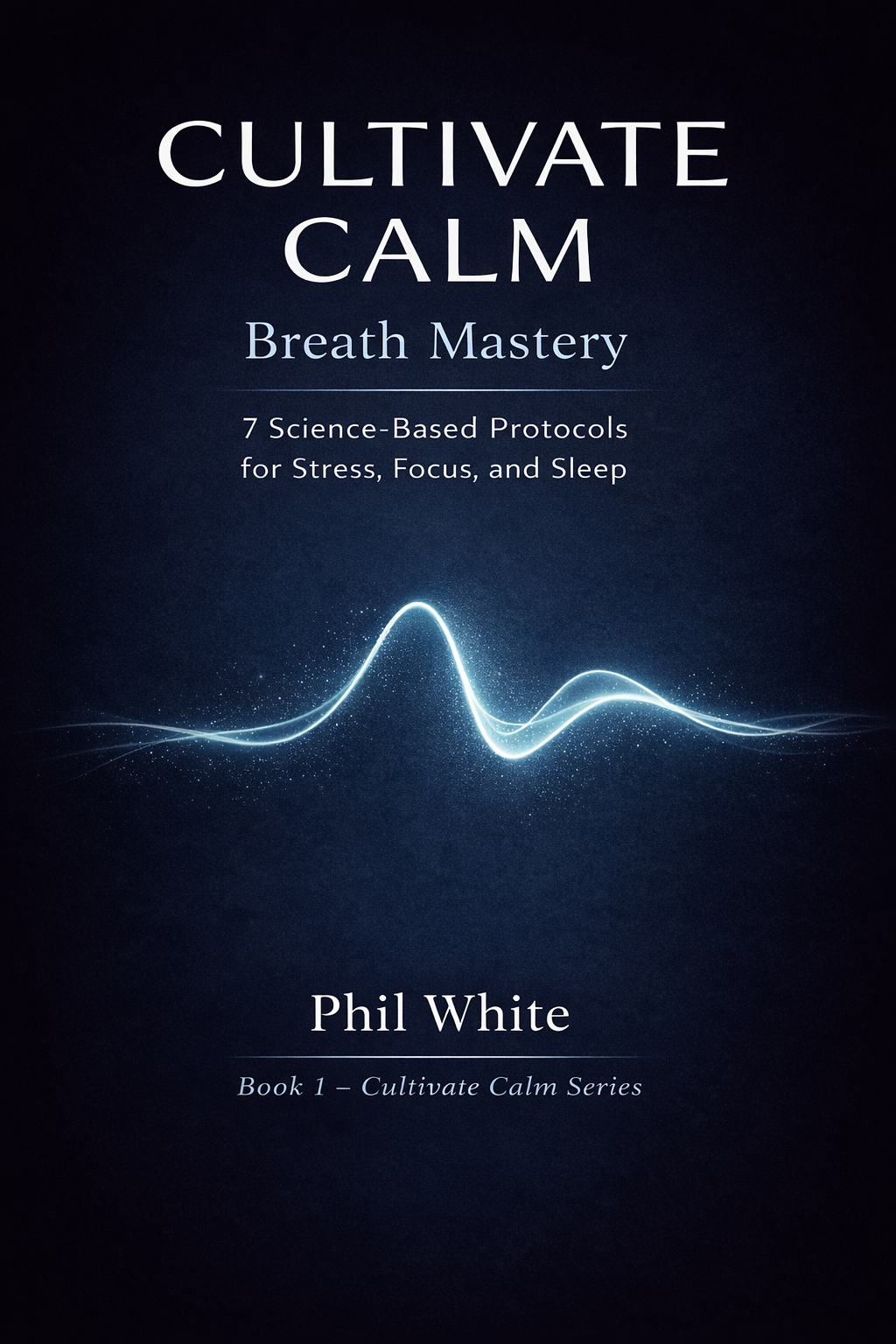
Stop Managing Stress. Start Controlling Your Nervous System.

7 science-backed breathing techniques. A decision card to know which to use when. A 30-day training log. The complete system for professionals who need to control their stress response — not just manage it.
$27 PDF — 49 pages + bonuses
You Know You Should Breathe Better. You’re Still Not Doing It.
There’s a reason breathing exercises feel like a wellness platitude: most of them are. Five-second inhale, exhale, feel marginally better. Nothing sticks. Nothing changes the way you react under pressure.
The real problem isn’t technique. It’s that breathing is being taught backwards. You need to understand what it does to your nervous system before the practice makes sense. Without the mechanism, there’s no reason to trust it — and you stop doing it.
Most breathing guides skip the science entirely. They give you a routine with no explanation. You follow it for three days and abandon it. This book does the opposite.
Most breathing resources skip the science. This one starts there.
Mechanism First. Practice Second.
Every technique in this book is explained from the inside out — what it activates in your autonomic nervous system, when that activation is appropriate, and how to deploy it deliberately.
The science of HRV
Why heart rate variability is the actual measure of nervous system control — and how breathing directly changes it.
Sympathetic vs. parasympathetic
The two systems that govern your stress response. Which to activate when, and why most people have the relationship backwards.
7 distinct techniques
Diaphragmatic, Box (4-4-4-4), 4-7-8, Coherent, HRV Resonance, Physiological Sigh, Nadi Shodhana. Each with clinical context.
Decision-based application
A framework for knowing which technique fits which situation — not a generic daily routine, but a contextual system.
49 Pages. 7 Techniques. One Complete System.
- The autonomic nervous system basics — what actually happens in your body during stress and recovery
- HRV explained for non-clinicians — the science behind why breathing works as a regulation tool
- All 7 breathing techniques — step-by-step instructions, physiological mechanism, optimal use case
- The Decision Card — a single-page reference: match your current state to the right technique instantly
- The 30-Day Training Log — a structured practice tracker to build the habit systematically
- Integration framework — how to use these tools in meetings, high-pressure moments, and daily regulation
The Difference Between Reacting and Responding
Without this
Stress spikes in the meeting. Decision quality drops. You recover an hour later, maybe.
With this
You have a 90-second technique that changes your physiological state. You choose your response.
Without this
You “know” you should breathe more, but nothing sticks because you don’t understand why it works.
With this
The mechanism is clear. The practice makes sense. You continue because you understand what you’re doing.
This book gives you the tools — and the science to trust them.
Built on 20+ Years of Professional Practice
Phil White is a personal development coach and tool provider based in Quebec. His work integrates behavioral psychology, NLP, and evidence-based practices to support professionals operating under sustained pressure. The Cultivate Calm series is his applied research in book form — each volume covering one regulation system, grounded in peer-reviewed science.
The techniques in this book are not original to Phil. The neuroscience is well-established. What’s original is the decision-based framework that makes the science immediately usable for working professionals.
Cultivate Calm — Book 1
PDF — 49 pages + Decision Card + 30-Day Training Log
- ✓ 49-page evidence-based guide
- ✓ 7 breathing techniques with clinical context
- ✓ The Decision Card — print or keep on phone
- ✓ 30-Day Training Log
- ✓ Instant download. Lifetime access.
Five Steps to Your First Result
FAQ
I’m not a beginner — is this too basic?
The techniques themselves are accessible. The science is not basic. If you already know the techniques, the clinical context and decision framework are what you’re missing.
How long does it take to read?
The guide is 49 pages. Most readers finish in one sitting (60–90 minutes). The techniques then take 5–10 minutes per session to practice.
How is this different from a breathing app?
An app times your breathing. This book explains why it works, which technique is appropriate for which situation, and how to develop the judgment to deploy it without external cues.
Is this therapy or a clinical treatment?
No. This is a practical skill-building tool for performance and nervous system regulation. If you’re dealing with a clinical mental health condition, work with a licensed professional. This book is not a substitute for clinical care.
How quickly will I see results?
Most practitioners report a measurable difference in their physiological response within 5–7 days of consistent use. Structural changes in HRV baseline require 4–6 weeks of regular practice.
What format and how do I access it?
PDF. Instant download via Gumroad after purchase. Works on any device. No app, no subscription. You own it permanently.