Where Emotions Actually Start in the Brain
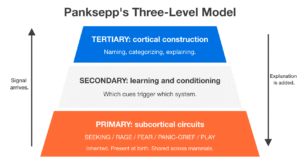
Emotion does not begin with interpretation. It begins in circuits older than our species. Here is the evidence, and the three-day test that shows it.
Emotion does not begin with interpretation. It begins in circuits older than our species. Here is the evidence, and the three-day test that shows it.
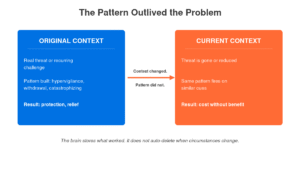
Destructive thought patterns do not come from nowhere. Each was built to solve a real problem. Here is what that means for changing them.
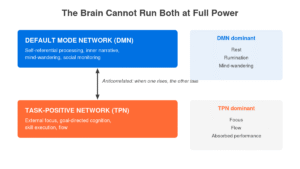
The absence of mental noise is not a spiritual state. It is a neurological one. Here is what actually happens in the brain when thought quiets.
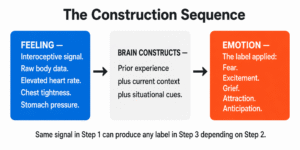
“We do not weep because we are sad; we are sad because we weep.” William James, Principles of Psychology, 1890 James proposed
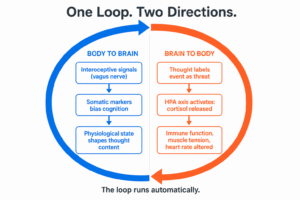
“There is nothing either good or bad, but thinking makes it so.” , William Shakespeare, Hamlet, Act 2 Scene 2, c. 1600
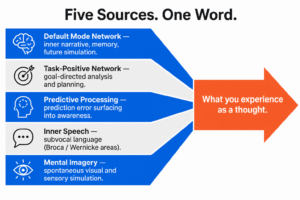
“I think, therefore I am.” , René Descartes, Discourse on the Method, 1637 Descartes was certain of one thing: the thought itself
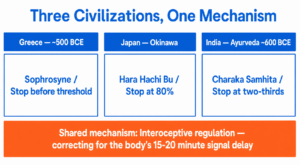
Around 500 BCE, three distinct civilizations (Greece, India, and China) independently began documenting the same observation: unchecked appetite leads to accelerated decline.
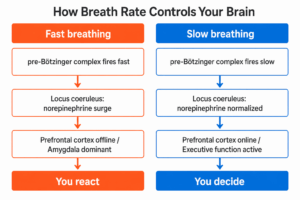
Breathing is not a calming technique. It’s a brain control mechanism. The prefrontal cortex, the region responsible for decision-making, impulse control, and
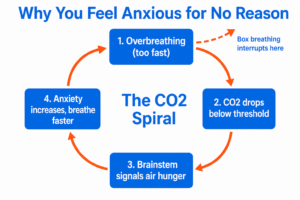
Most breathing advice focuses on oxygen. Wrong target. The real variable is carbon dioxide tolerance. Low CO2 tolerance equals chronic overbreathing equals
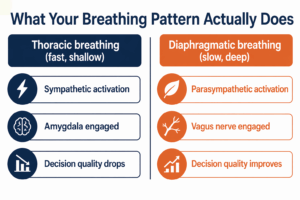
Most professionals default to thoracic breathing under stress. Shallow. Fast. High in the chest. This is a sympathetic activation pattern, associated with

Picture a family dinner. An uncle leans toward a baby and grins. “Say my name! Say Uncle Anthony!” The baby babbles. Sounds
You understand everything. But you can’t speak. If you’ve ever learned a language, you know this feeling. You read the text. You
You’ve spent two weeks learning how memory actually works. Blog 1 showed you the mechanism. Encoding, consolidation, retrieval. Your brain doesn’t store
You already know HOW memory works, encoding, consolidation, retrieval. Now here’s the part that actually matters: how to make it work better.
You use your memory constantly. You recall where you parked. You recognize faces. You speak sentences. But ask most people what a
The Adult Language Myth (and why You’re actually built for this) Let me cut through the nonsense right now. You’ve been sold
Welcome, fellow traveler. Today is the beginning of a journey that many start, but not everyone completes. Yours will be different. I’m