Most professionals default to thoracic breathing under stress. Shallow. Fast. High in the chest. This is a sympathetic activation pattern, associated with anxious states and linked to sustained amygdala activity. Cognitive function drops. You make worse decisions precisely when you need better ones.
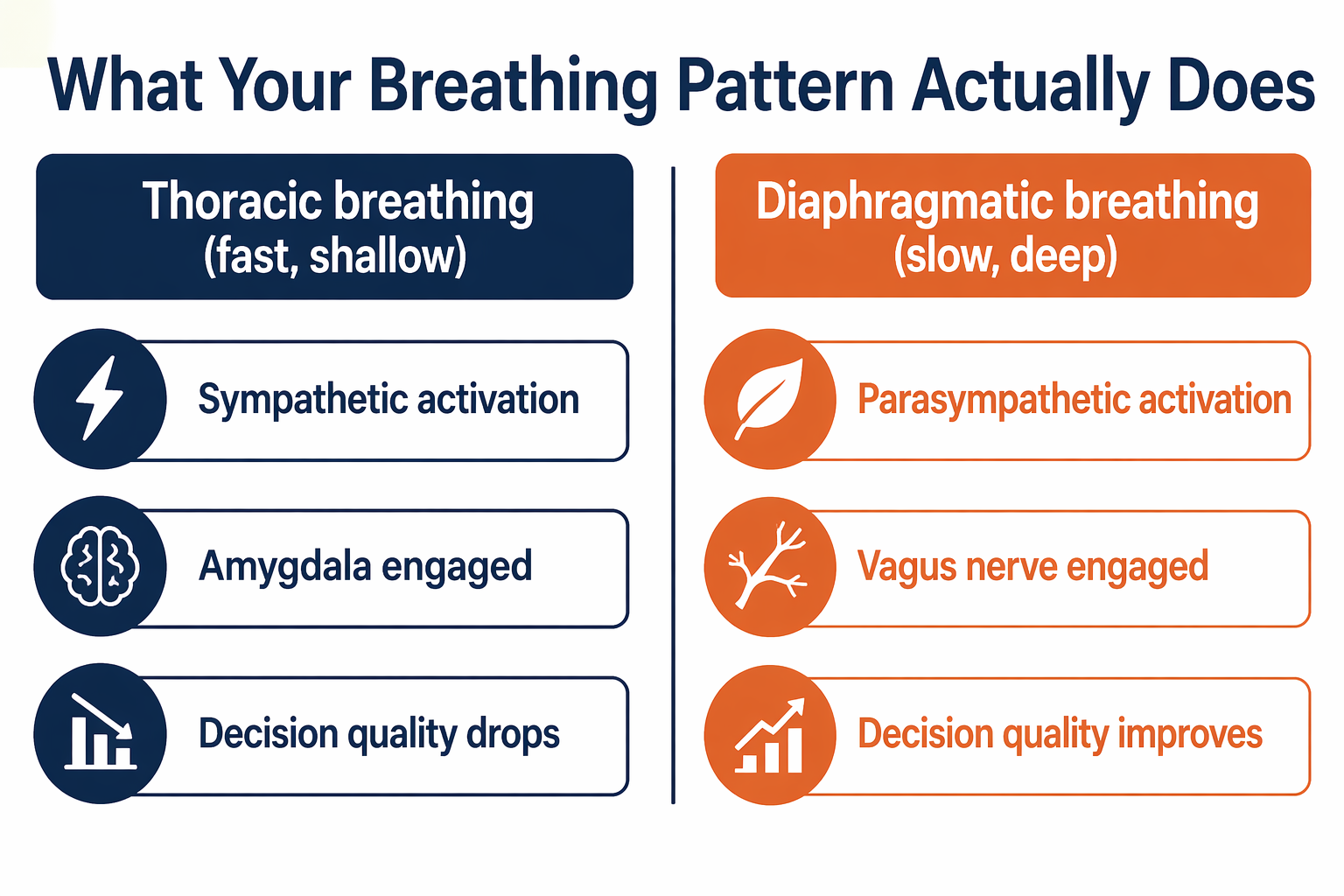
Here’s What’s Actually Happening
Respiratory rate directly modulates autonomic state (Zaccaro et al., 2018). Slowing your breathing to around 6 breaths per minute, the resonance frequency, is associated with maximal vagal engagement, shifting autonomic balance toward parasympathetic dominance within seconds (Gerritsen & Band, 2018). The autonomic shift is near-immediate; cortisol, a slower hormone, settles over the minutes that follow. This isn’t meditation. This isn’t mindfulness. This is respiratory physiology, the fastest lever you have over your nervous system.
The mechanism: slow exhalation stretches pulmonary stretch receptors, which signal the nucleus tractus solitarius via vagal afferents, which inhibits sympathetic outflow. You don’t need to believe in it. It’s a reflex arc. It fires whether you believe or not.
Try This. Seriously, Just Do It.
The physiological sigh. A long-known respiratory reflex the body already uses to reset breathing, tested as a deliberate practice by a Stanford team (Balban et al., 2023). Double inhale through the nose, short inhale, then a second top-up inhale to maximally inflate the alveoli, followed by an extended exhale through the mouth.
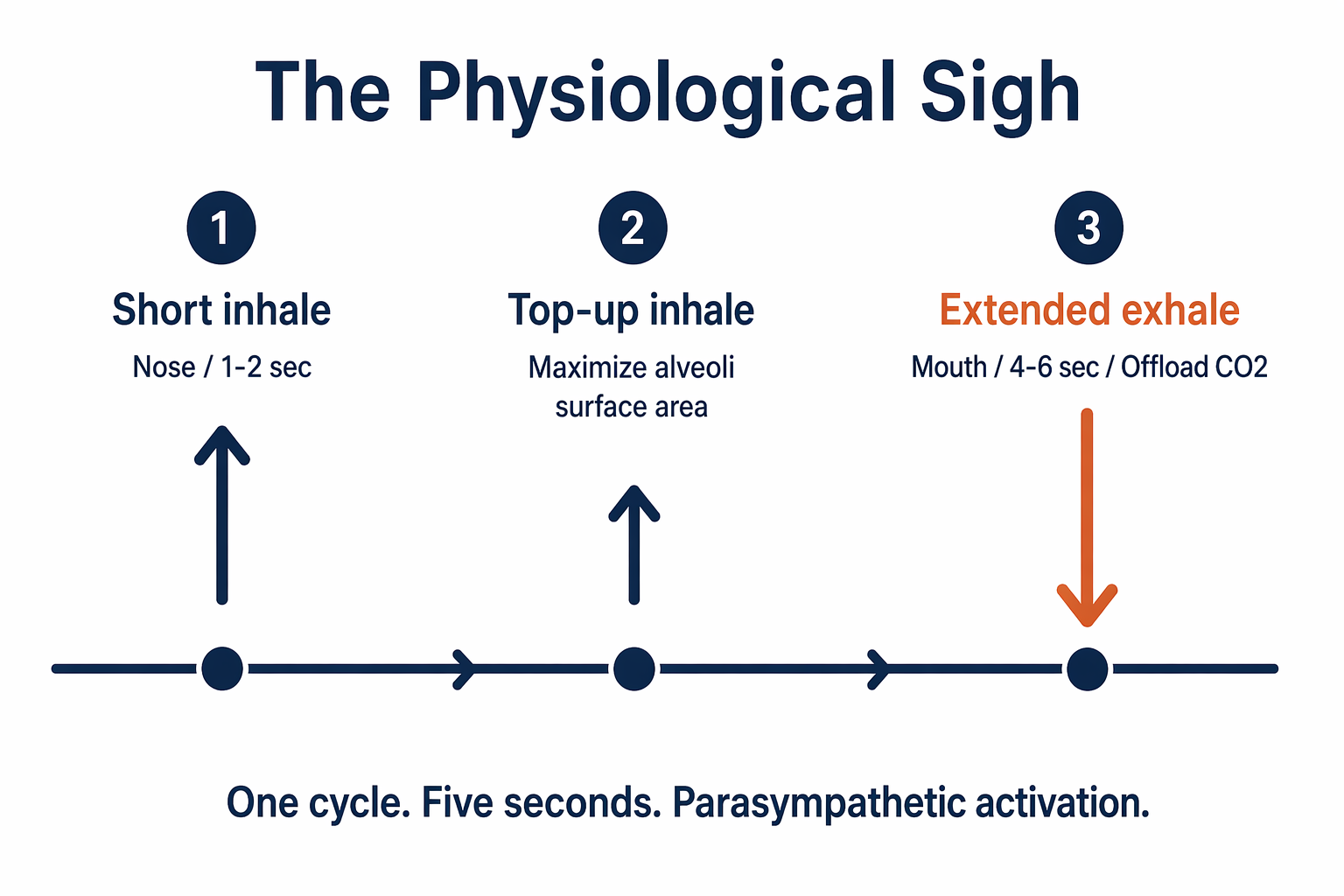
One cycle. Five seconds. A rapid parasympathetic reset. In the month-long Stanford trial, five minutes a day of cyclic sighing improved mood and lowered resting breathing rate more than mindfulness meditation.
In the Stanford comparison, it outperformed the other tested techniques for improving mood. It works because the double inhale is thought to reinflate collapsed alveoli, improving gas exchange so CO2 offloads more efficiently on the exhale. The long exhale activates the parasympathetic brake.
You don’t need 20 minutes of meditation to regulate. You need 30 seconds of respiratory precision. The technique exists. The science is clear. The question is whether you’ll use it when the pressure comes.
If you want the full protocol, 7 breathing techniques ranked by speed, context, and nervous system state, that’s in Cultivate Calm: Breath Mastery.
Citations
Zaccaro, A., Piarulli, A., Laurino, M., et al. (2018). How breath-control can change your life. Frontiers in Human Neuroscience, 12, 353.
Gerritsen, R. J. S., & Band, G. P. H. (2018). Breath of life: The respiratory vagal stimulation model. Frontiers in Human Neuroscience, 12, 397.
Balban, M. Y., Neri, E., Kogon, M. M., et al. (2023). Brief structured respiration practices enhance mood and reduce physiological arousal. Cell Reports Medicine, 4(1), 100895.
Build the physiological layer first. Cultivate Calm: Breath Mastery is the breath and nervous-system regulation foundation the rest of this work is built on: seven techniques matched to seven nervous-system states, with progression protocols and real-time decision trees.
Get Cultivate Calm: Breath Mastery ($27)