Where Emotions Actually Start in the Brain
Emotion does not begin with interpretation. It begins in circuits older than our species. Here is the evidence, and the three-day test that shows it.

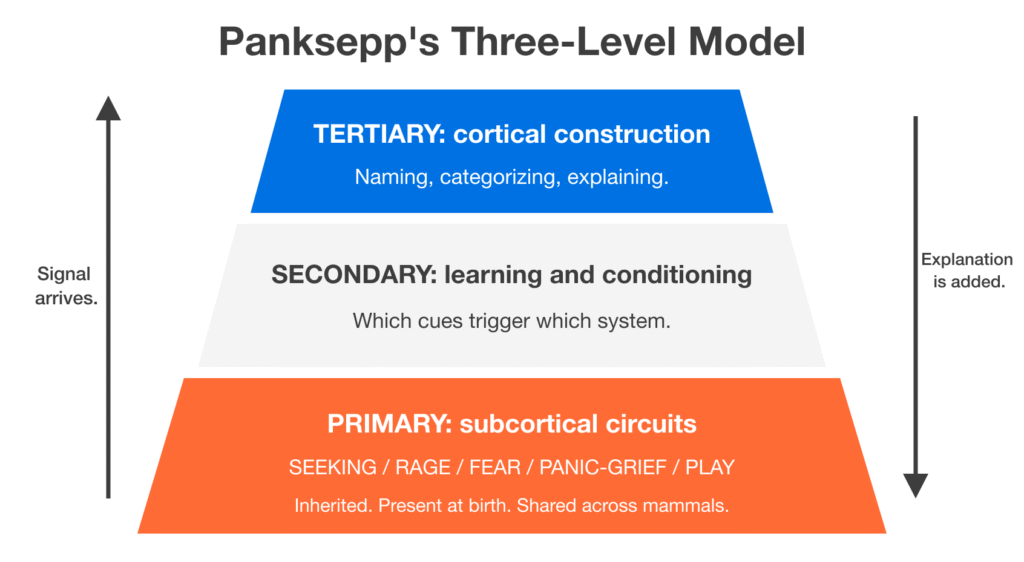
Emotion does not begin with interpretation. It begins in circuits older than our species. Here is the evidence, and the three-day test that shows it.
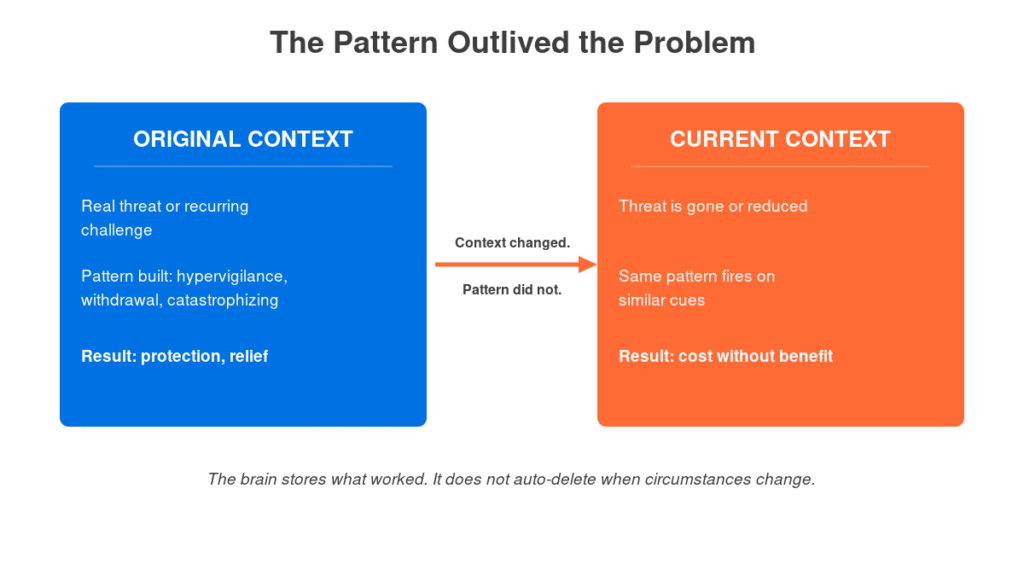
Destructive thought patterns do not come from nowhere. Each was built to solve a real problem. Here is what that means for changing them.
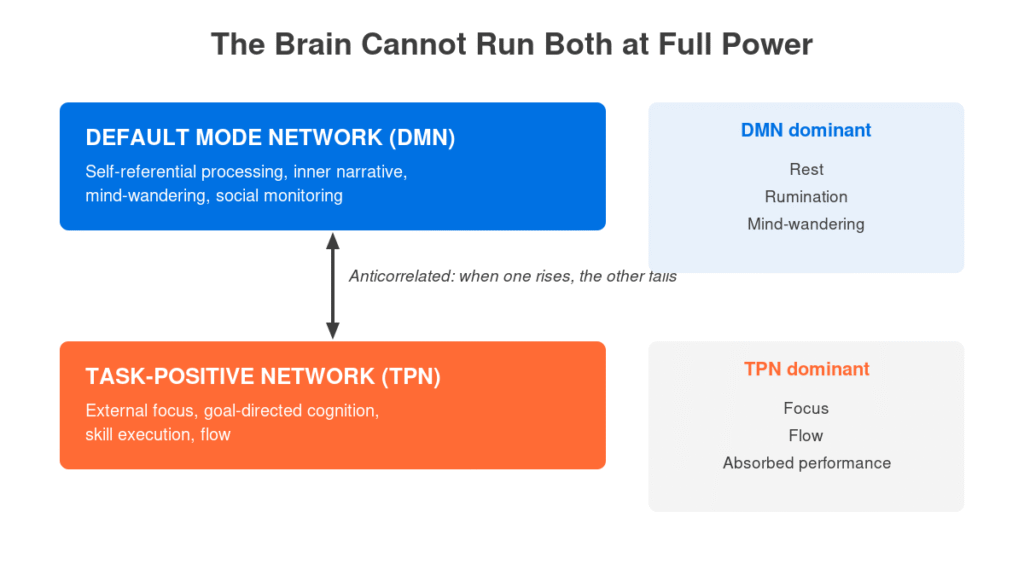
The absence of mental noise is not a spiritual state. It is a neurological one. Here is what actually happens in the brain when thought quiets.
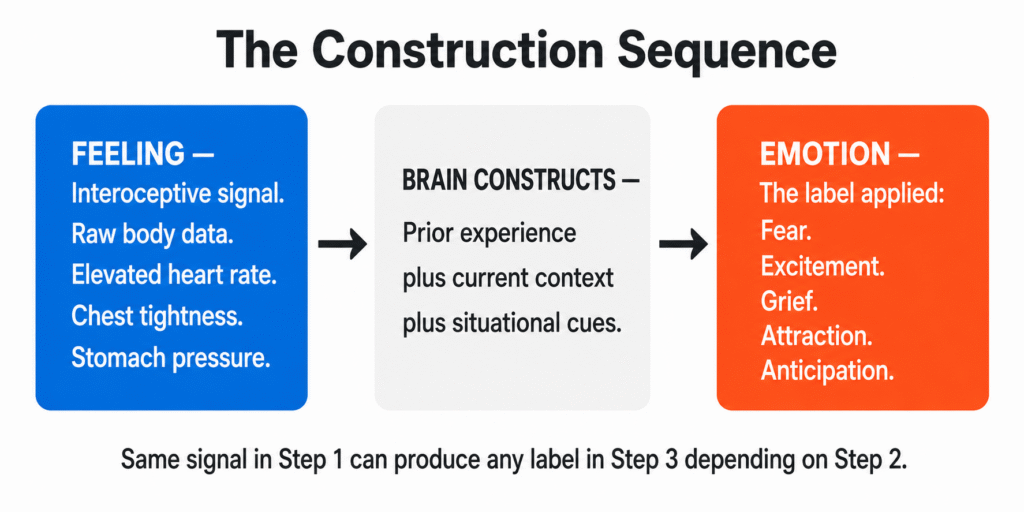
“We do not weep because we are sad; we are sad because we weep.” William James, Principles of Psychology, 1890 James proposed this in 1890 and it drew heavy criticism, notably from Walter Cannon, though the idea never fully disappeared. It took another century of neuroscience, and the work of Lisa Feldman Barrett, to document
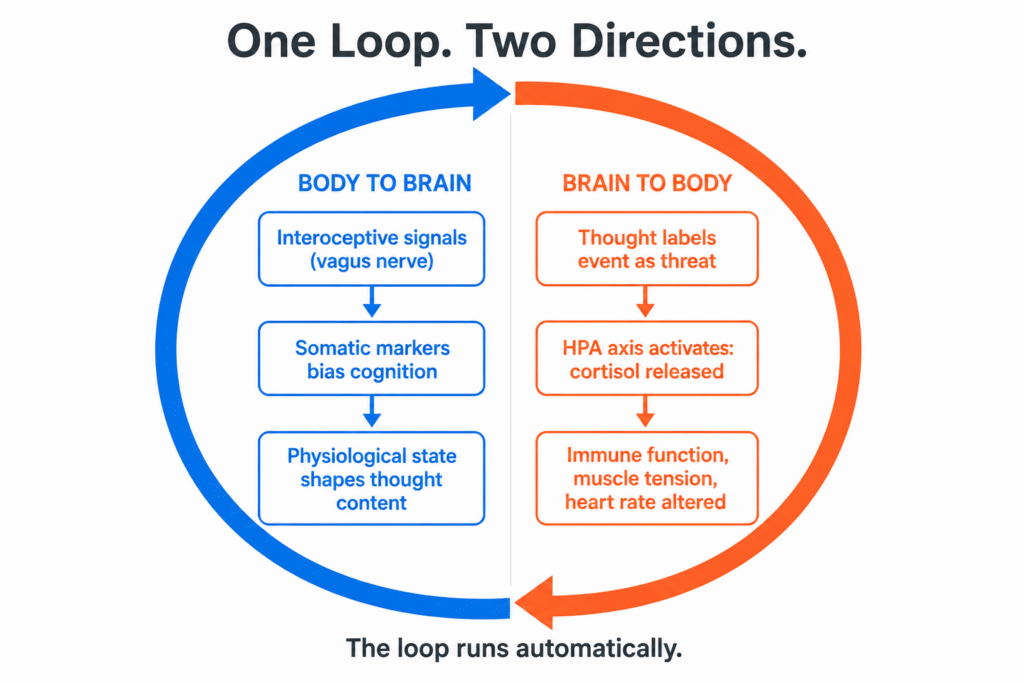
“There is nothing either good or bad, but thinking makes it so.” , William Shakespeare, Hamlet, Act 2 Scene 2, c. 1600 Shakespeare was writing about perception and moral relativism. He was also, without the vocabulary for it, describing a physiological mechanism that science would take 400 years to document precisely. The thought that labels

“I think, therefore I am.” , René Descartes, Discourse on the Method, 1637 Descartes was certain of one thing: the thought itself proved his existence. What he could not account for, and what no philosopher could until the 20th century, was what was generating the thought in the first place. He assumed he was the
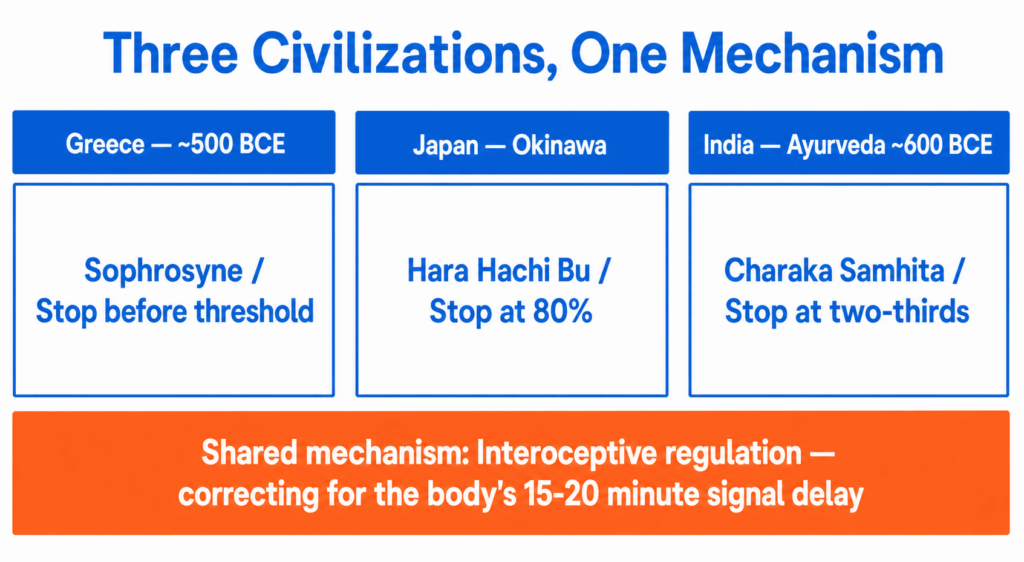
Around 500 BCE, three distinct civilizations (Greece, India, and China) independently began documenting the same observation: unchecked appetite leads to accelerated decline. They had no contact with each other. They used different languages, different frameworks, different cosmologies. Yet they converged on nearly identical behavioral prescriptions. That convergence is not a coincidence. It is evidence. What
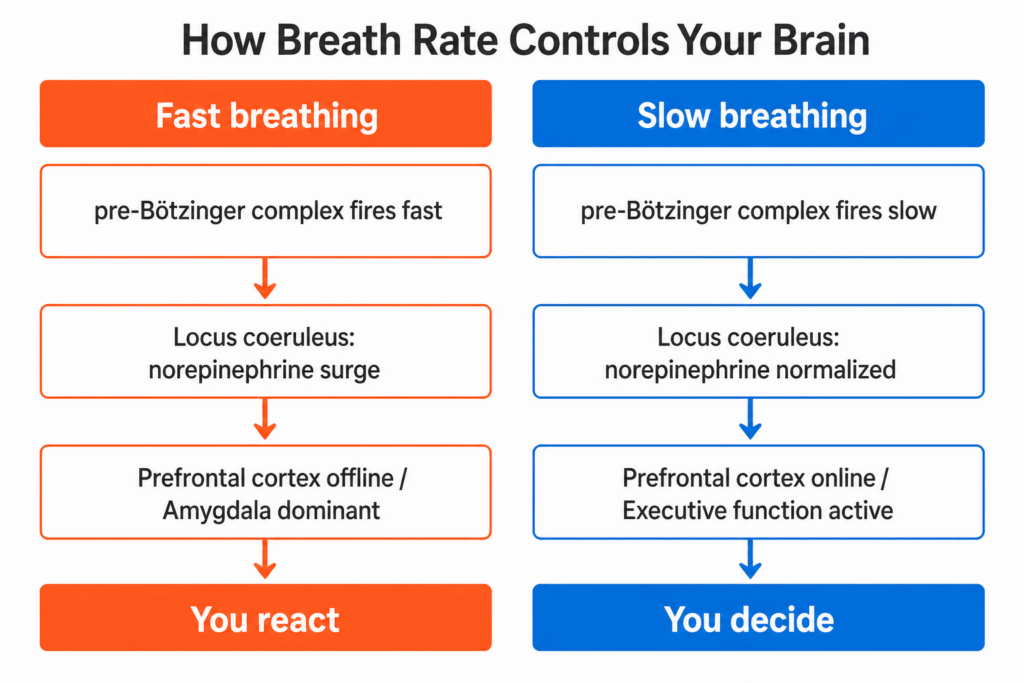
Breathing is not a calming technique. It’s a brain control mechanism. The prefrontal cortex, the region responsible for decision-making, impulse control, and executive function, is directly modulated by respiratory rhythm. When you breathe fast, prefrontal activity decreases. When you breathe slowly, it increases. You are literally thinking better or worse based on how you breathe.
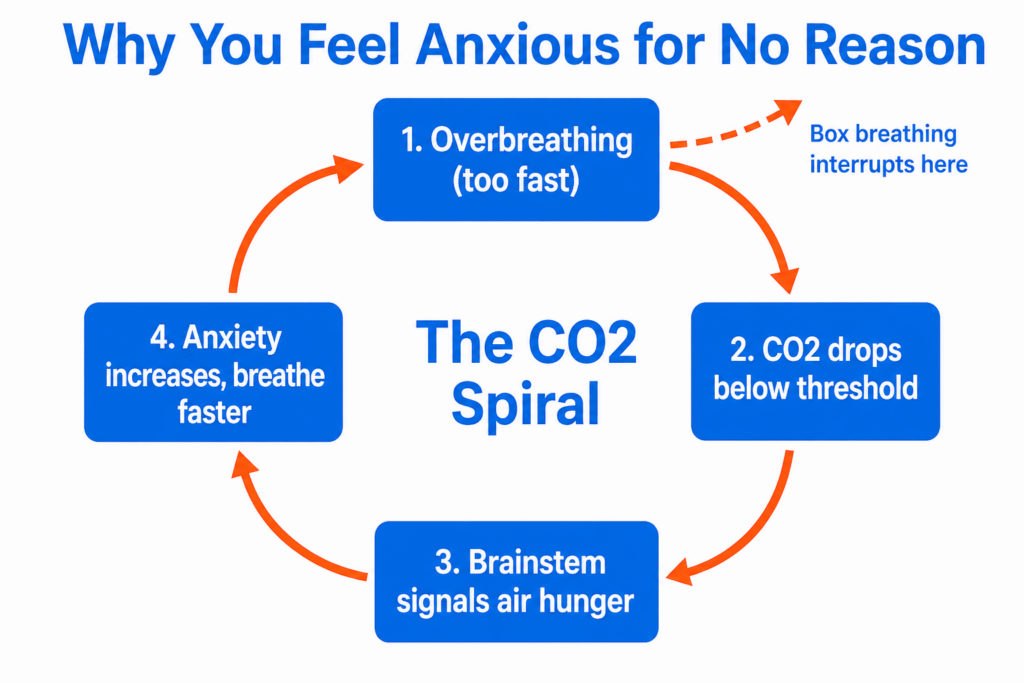
Most breathing advice focuses on oxygen. Wrong target. The real variable is carbon dioxide tolerance. Low CO2 tolerance equals chronic overbreathing equals chronic sympathetic activation. Chronic overbreathing resets your brainstem to panic at CO2 levels a calmer nervous system tolerates easily. That’s why you feel anxious for no apparent reason, your blood chemistry trips a
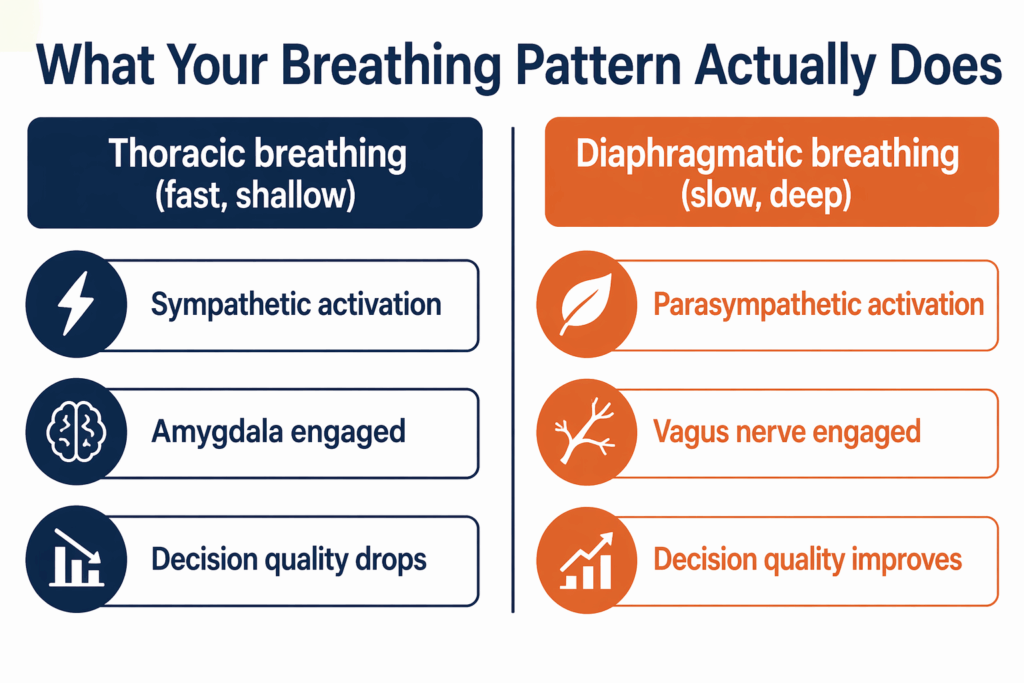
Most professionals default to thoracic breathing under stress. Shallow. Fast. High in the chest. This is a sympathetic activation pattern, associated with anxious states and linked to sustained amygdala activity. Cognitive function drops. You make worse decisions precisely when you need better ones. Here’s What’s Actually Happening Respiratory rate directly modulates autonomic state (Zaccaro et

Picture a family dinner. An uncle leans toward a baby and grins. “Say my name! Say Uncle Anthony!” The baby babbles. Sounds come out, but not words. Not yet. Then the older sibling, maybe four years old, delivers the verdict: “He can’t. He can’t speak.” Nobody thinks twice about it. It’s cute, it’s funny, and
You understand everything. But you can’t speak. If you’ve ever learned a language, you know this feeling. You read the text. You get the grammar. You know the words. But when someone talks to you, your mind goes blank. This is the most common problem in adult language learning. And it’s not about motivation. It’s
You’ve spent two weeks learning how memory actually works. Blog 1 showed you the mechanism. Encoding, consolidation, retrieval. Your brain doesn’t store files. It rebuilds patterns. Blog 2 gave you the six conditions. Attention. Emotion. Testing. Spacing. Sleep. Movement. Now the question everyone’s been waiting for: what about the people who memorize 3,000 digits of
You already know HOW memory works, encoding, consolidation, retrieval. Now here’s the part that actually matters: how to make it work better. Most people treat memory like a muscle. They think harder effort means better results. They re-read the same paragraph five times. They cram the night before. They get frustrated when nothing sticks. Your
You use your memory constantly. You recall where you parked. You recognize faces. You speak sentences. But ask most people what a memory is, and they default to metaphors. Filing cabinets. Hard drives. Storage boxes in the attic. None of which are accurate. A memory isn’t stored in one place. It’s a pattern your brain recreates.
The Adult Language Myth (and why You’re actually built for this) Let me cut through the nonsense right now. You’ve been sold a lie about language learning. The story goes: children are natural language geniuses, their brains are “wired differently,” and after puberty, you’re basically screwed. Your window closed. Game over. Except the research shows
Welcome, fellow traveler. Today is the beginning of a journey that many start, but not everyone completes. Yours will be different. I’m Phil, I have guided students through this exciting journey for over two decades, and I have walked it myself six times. I have studied French, English, Latin, Spanish, Greek, and Portuguese. Here is