Most breathing advice focuses on oxygen. Wrong target. The real variable is carbon dioxide tolerance. Low CO2 tolerance equals chronic overbreathing equals chronic sympathetic activation. Chronic overbreathing resets your brainstem to panic at CO2 levels a calmer nervous system tolerates easily. That’s why you feel anxious for no apparent reason, your blood chemistry trips a threat alarm at the smallest rise in CO2, even when there isn’t a real threat.
Here’s What’s Actually Happening
The Bohr Effect (Bohr, Hasselbalch & Krogh, 1904): hemoglobin releases oxygen more efficiently in the presence of adequate CO2. When you overbreathe, which most stressed professionals do unconsciously, you blow off CO2, constrict cerebral blood vessels, and paradoxically reduce oxygen delivery to the brain. You’re breathing more but getting less.
This creates a vicious cycle. Your brainstem chemoreceptors detect rising CO2 and signal “air hunger,” the feeling that you can’t get enough air. Chronic overbreathing lowers the threshold at which that alarm fires, so the normal CO2 that builds between breaths now trips it too early. You breathe more to chase the feeling of relief. Which keeps CO2 chronically low. Which keeps the threshold sensitized. Which keeps anxiety high.
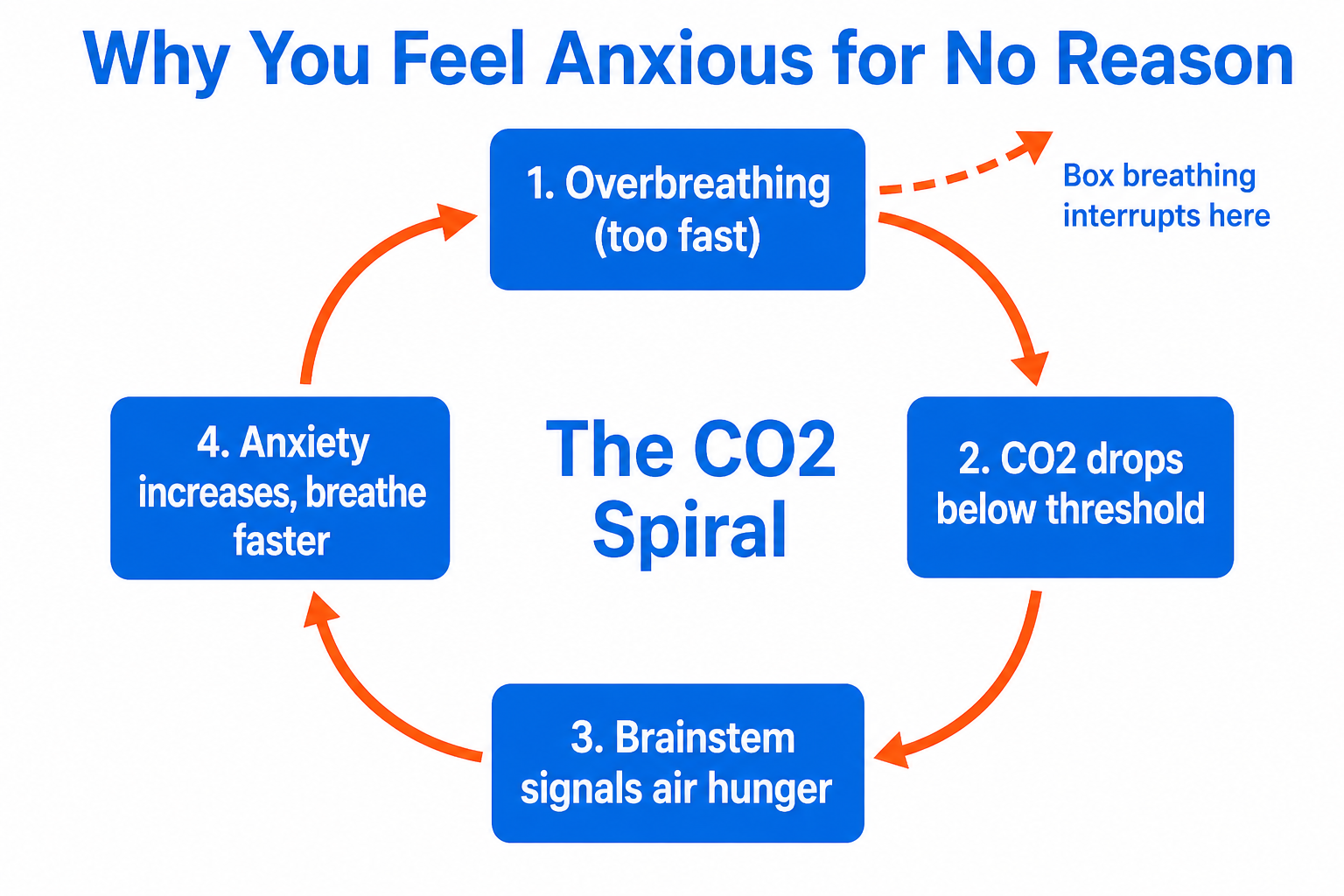
Extended exhale techniques and breath holds build CO2 tolerance (Courtney, 2009). They train your chemoreceptors to tolerate higher CO2 without triggering the panic response. This raises your threshold for stress activation. You become neurologically harder to destabilize.
Try This. Seriously, Just Do It.
Box breathing with progressive hold extension.
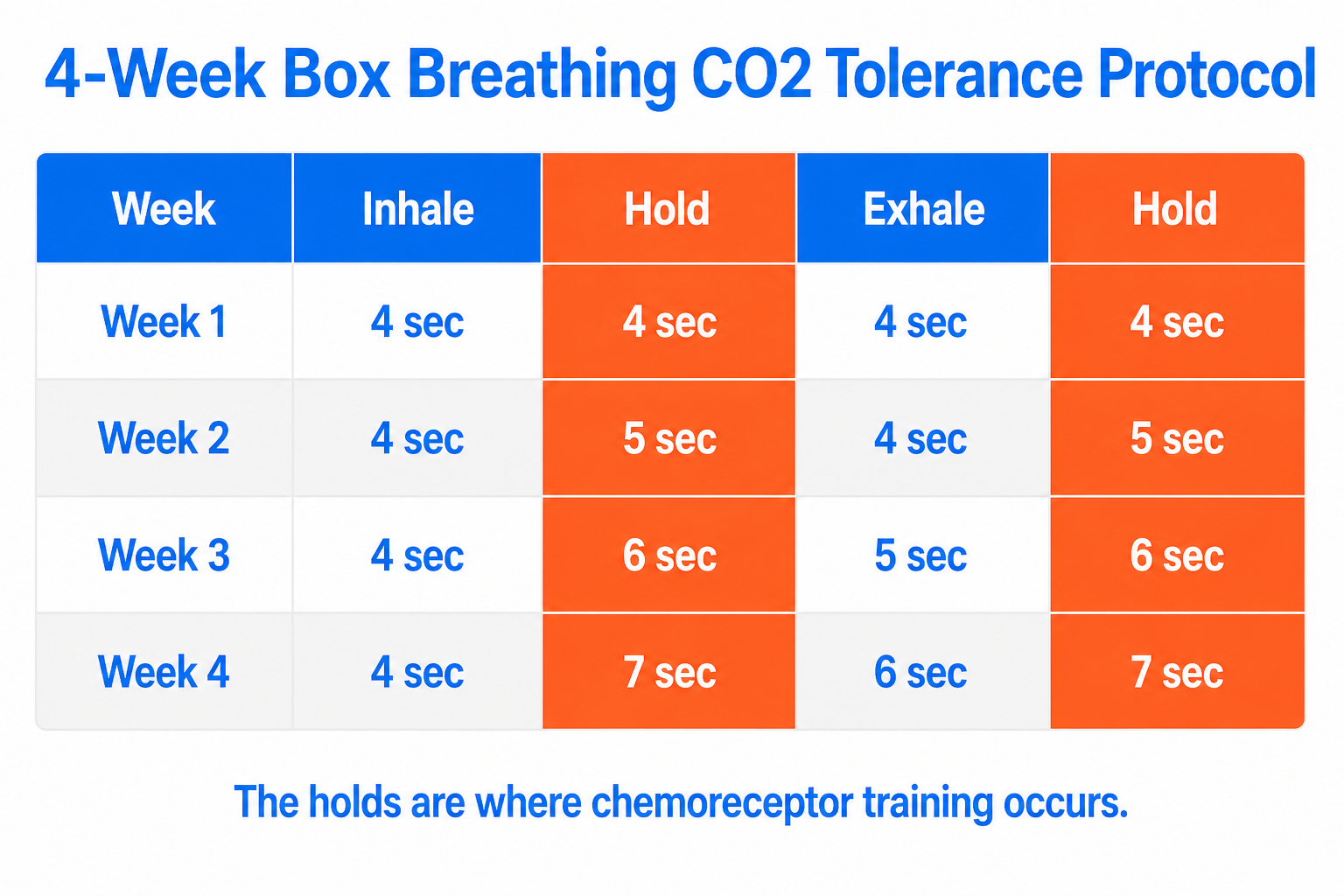
Week 1: Inhale 4 seconds. Hold 4 seconds. Exhale 4 seconds. Hold 4 seconds.
Week 2: Inhale 4. Hold 5. Exhale 4. Hold 5.
Week 3: Inhale 4. Hold 6. Exhale 5. Hold 6.
Week 4: Inhale 4. Hold 7. Exhale 6. Hold 7.
The holds are where the CO2 tolerance training happens. Each week, you’re teaching your chemoreceptors that elevated CO2 is safe. Your stress threshold rises. Your baseline anxiety drops. Not because you “feel better”, because your blood chemistry has actually changed.
Anxiety is not always psychological. Sometimes it’s respiratory. If your CO2 tolerance is low, no amount of positive thinking will override the brainstem alarm. Fix the breathing. The anxiety follows.
This is the biology most breathing apps skip entirely. If you want the full CO2 tolerance protocol and 6 other techniques calibrated to your specific nervous system state, that’s in Cultivate Calm: Breath Mastery.
Build the physiological layer first. Cultivate Calm: Breath Mastery is the breath and nervous-system regulation foundation the rest of this work is built on: seven techniques matched to seven nervous-system states, with progression protocols and real-time decision trees.
Get Cultivate Calm: Breath Mastery ($27)