“The chains of habit are too weak to be felt until they are too strong to be broken.”
Samuel Johnson, 1783
Johnson was describing a behavioral phenomenon. He was also, without intending it, naming the central problem of cognitive pattern change: the mechanism that locks a response in place is invisible while it is forming and only becomes visible once it has become structural.
The thought pattern causing damage today was built to prevent damage. That distinction changes everything about how you approach it.
What I Have Watched Repeatedly
Across 25 years of behavioral coaching work, I have watched a consistent pattern in people who arrive with what they describe as self-sabotage, chronic anxiety, or thought loops they cannot exit.
They are not weak. They are not broken. They are running a cognitive solution that was written for a context that no longer exists.
The person who catastrophizes before every important meeting was once a child in an environment where anticipating the worst was the most reliable way to avoid being caught off-guard. The person who deflects every compliment was once in a relationship where visibility produced attack. The person who cannot stop replaying a failure was once in a situation where one mistake had real, lasting consequences and thorough post-mortem analysis was survival behavior.
The pattern was not random. It was selected for. It worked. The brain stored it as a reliable response to a category of situation, and it fires on any stimulus that resembles the original cue. The context changed. The pattern did not receive the update.
The Argument
Behavioral neuroscience and learning theory converge on the same point: the brain strengthens patterns through repeated use, and rarely keeps ones that never pay off. A thought loop that costs the person running it must have produced a benefit at some point, or it would have been extinguished through natural feedback.
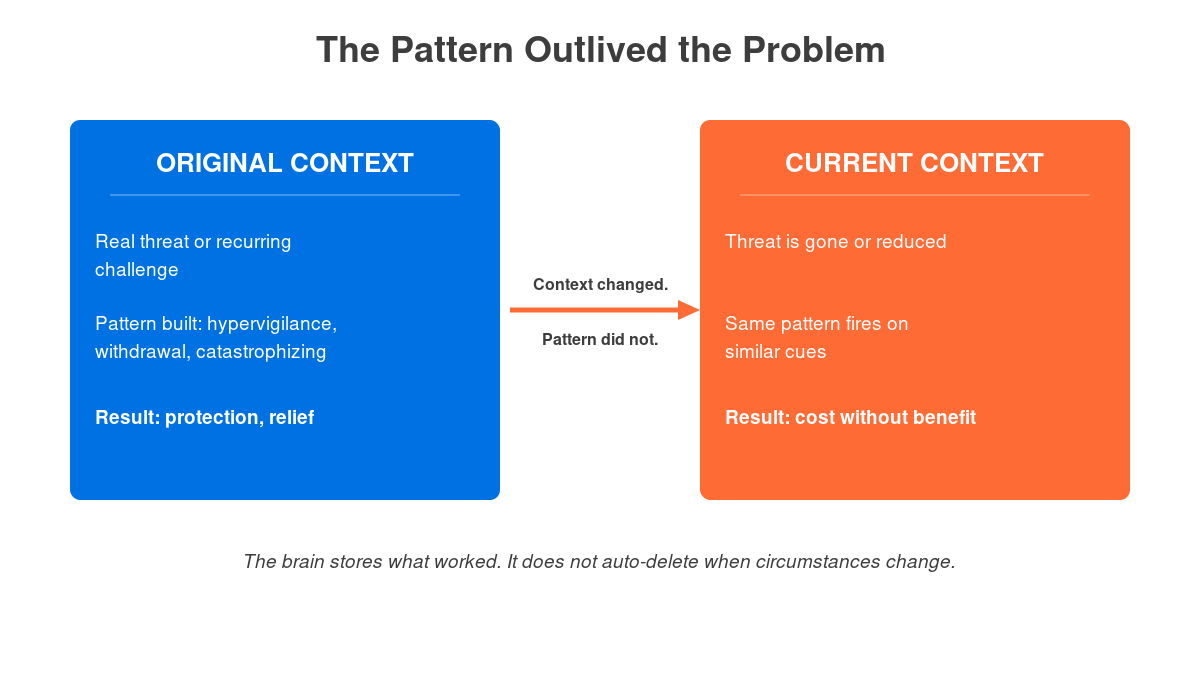
Joseph LeDoux at New York University documented the persistence of fear-conditioned responses: once a threat association is formed in the amygdala, it is not erased by new learning. It is suppressed by competing associations. The original trace remains. This is why thought patterns linked to past threat do not disappear when the threat is removed. They are inhibited by new context, but the original association is intact and will resurface when conditions are similar enough.
Decades of reinforcement-learning research add the other side: the same mechanism that builds limiting patterns also builds capable ones. The brain’s associative learning system does not distinguish between useful and counterproductive. It records what co-occurred with safety, success, relief, or survival, and it reinstates those patterns when the relevant cues appear.
The problem is not that the brain built the pattern. The problem is that the pattern generalized beyond its original context and was never revised when the context changed.
The Counterpoint
The strongest objection to this frame is: some thought patterns seem to have no meaningful origin. Intrusive thoughts in obsessive-compulsive presentations, for instance, do not always map cleanly to a formative protective function. Some patterns appear to be noise, not signal.
This objection has weight. Not every thought pattern has a traceable adaptive origin. Some are artifacts of misfire, generalization errors, or random association.
But the frame does not require that every pattern has a clean origin story. It requires only that you approach the pattern as if it might have one. That shift in stance, from “this is a defect in me” to “this may be a solution to a problem I no longer have,” changes the relationship to the pattern before you know anything about its origin. And that change in relationship is often what makes investigation possible.
You cannot trace what you are busy fighting.
What This Means for Change
The conventional approach to unwanted thought patterns is suppression or replacement. Stop thinking that. Think this instead. The research on thought suppression, documented by Daniel Wegner through his white bear experiments (1987, at Trinity University), points to what many people discover on their own: for many, deliberate suppression can increase the frequency of the suppressed thought. The act of monitoring for the thought activates the network that generates it.
The alternative is not acceptance in the passive sense. It is investigation. What problem was this pattern built to solve? When did it work? What cue is currently triggering it? Is that cue actually similar to the original situation, or has the pattern generalized to a context that has none of the original features?
These are not rhetorical questions. They are diagnostic ones. And they produce different information than suppression does.
The Closing Argument
Dostoevsky attributed pain and suffering to intelligence and depth. The more accurate attribution is to intelligence and depth operating on outdated information.
The thought patterns that generate the most suffering are often the most sophisticated responses to the most serious threats a person has faced. They deserve examination, not condemnation. They were built by a system doing exactly what it was designed to do.
The work is not to destroy what the brain built. It is to update the file.
Takeaway: The thought hurting you was written by a version of you trying to survive something real. The question worth asking is not “why do I keep thinking this?” It is “what was this thought originally protecting me from?”
The physiological layer that makes this kind of investigation accessible, a regulated nervous system, a brain not running on chronic threat response, is the starting point. Cultivate Calm: Breath Mastery builds that foundation.
If you want to trace the origin of a specific pattern rather than understanding the mechanism in the abstract, that is the applied work. You can find out if it is the right fit here: one-on-one coaching.
The full system these posts are built on, The Calibration Compass, the diagnostic-and-installation framework for finding where a pattern breaks down and revising it, is in development. This series is the groundwork.
This is the final post in The Thought Series. It began with where thoughts come from and ends with what to do when one of them outlives its purpose.
Research Referenced
LeDoux, J.E. (2000). Emotion circuits in the brain. Annual Review of Neuroscience, 23, 155, 184. New York University, Center for Neural Science. [Persistence of fear-conditioned associations in the amygdala]
Bandura, A. (1997). Self-Efficacy: The Exercise of Control. W.H. Freeman. Stanford University. [Associative learning builds both limiting and capable patterns]
Wegner, D.M., Schneider, D.J., Carter, S.R., & White, T.L. (1987). Paradoxical effects of thought suppression. Journal of Personality and Social Psychology, 53(1), 5, 13. Harvard University. [White bear experiments: suppression increases the suppressed thought]
Johnson, S. (1783), recorded in Boswell, J. (1791). The Life of Samuel Johnson. [Historical framing on the formation of habit]
Dostoevsky, F. (1866). Crime and Punishment. [Framing on intelligence, depth, and suffering]