Breathing is not a calming technique. It’s a brain control mechanism. The prefrontal cortex, the region responsible for decision-making, impulse control, and executive function, is directly modulated by respiratory rhythm. When you breathe fast, prefrontal activity decreases. When you breathe slowly, it increases. You are literally thinking better or worse based on how you breathe.
Here’s What’s Actually Happening
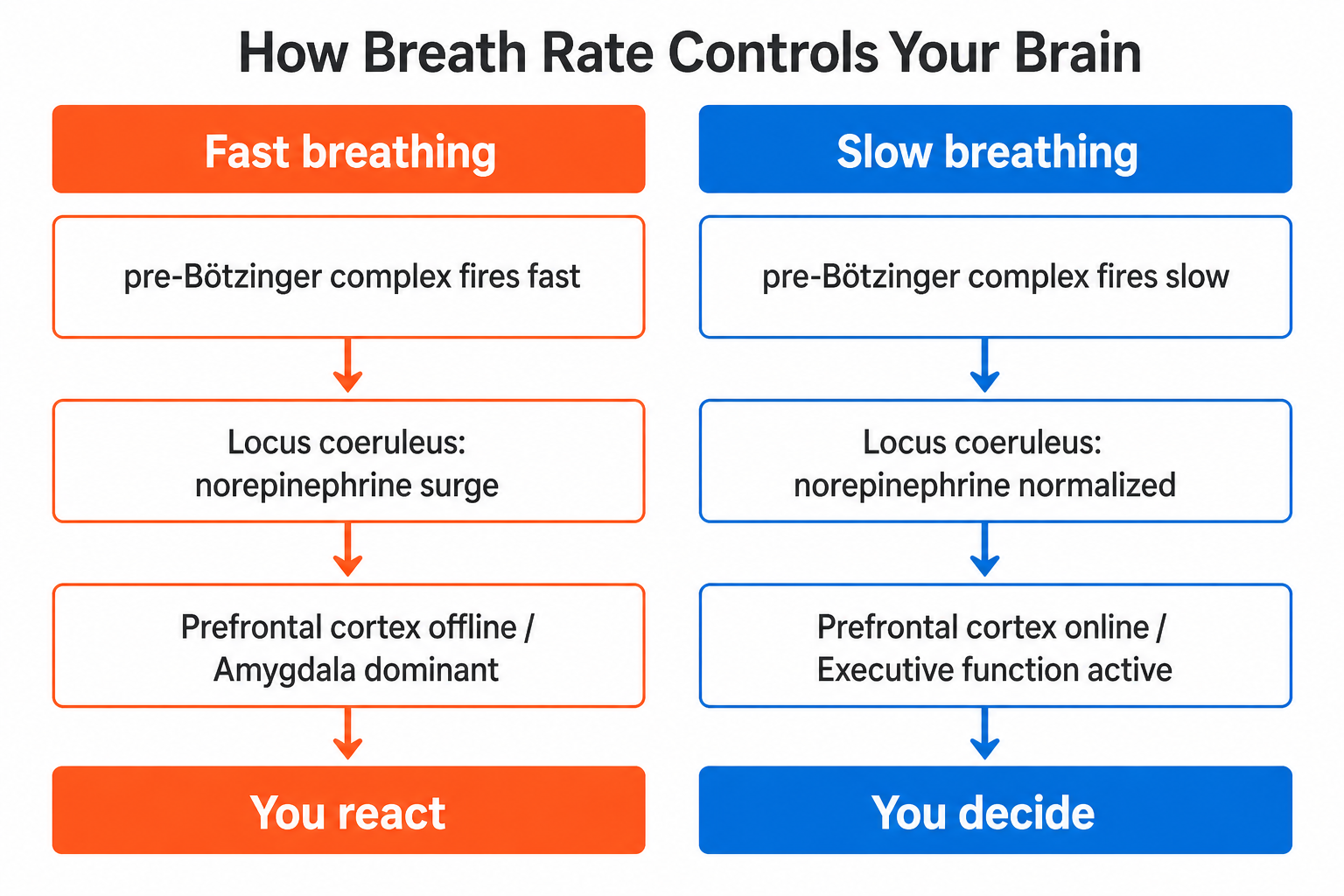
The pre-Bötzinger complex in the brainstem generates respiratory rhythm. In 2017, Yackle and colleagues at Stanford identified a small cluster of neurons in this complex that project directly to the locus coeruleus, the brain’s primary norepinephrine hub. The locus coeruleus controls arousal, attention, and stress reactivity across the entire cortex.
When you breathe fast: locus coeruleus firing increases, cortical norepinephrine likely rises, prefrontal cortex activity drops, the amygdala takes over, and you react instead of deciding.
When you breathe slowly, the proposed mechanism runs like this: locus coeruleus firing decreases, norepinephrine likely normalizes, and prefrontal cortex engagement is thought to increase, supporting executive function over reactive response. That full chain hasn’t been directly measured in humans, but the behavioral outcome, better decision making under slow breathing, is well supported.
This is not metaphorical. This is a documented neural pathway. In one controlled trial, Ma and colleagues (2017) found that eight weeks of slow diaphragmatic breathing improved sustained attention, lowered negative affect, and reduced cortisol, all consistent with restored prefrontal regulation.
The implication is direct: your breath rate is a measurable input to your cognitive capacity. Every meeting you enter breathing fast, you enter with reduced executive function. Every negotiation you approach with controlled breathing, you approach with enhanced decision-making.
Try This. Seriously, Just Do It.
Cadence breathing: fixed inhale-to-exhale ratio of 1:2.
Inhale 4 seconds. Exhale 8 seconds. This ratio maximizes vagal activation per breath cycle because the exhale phase is when the vagus nerve fires strongest. Parasympathetic activation occurs primarily during exhalation.
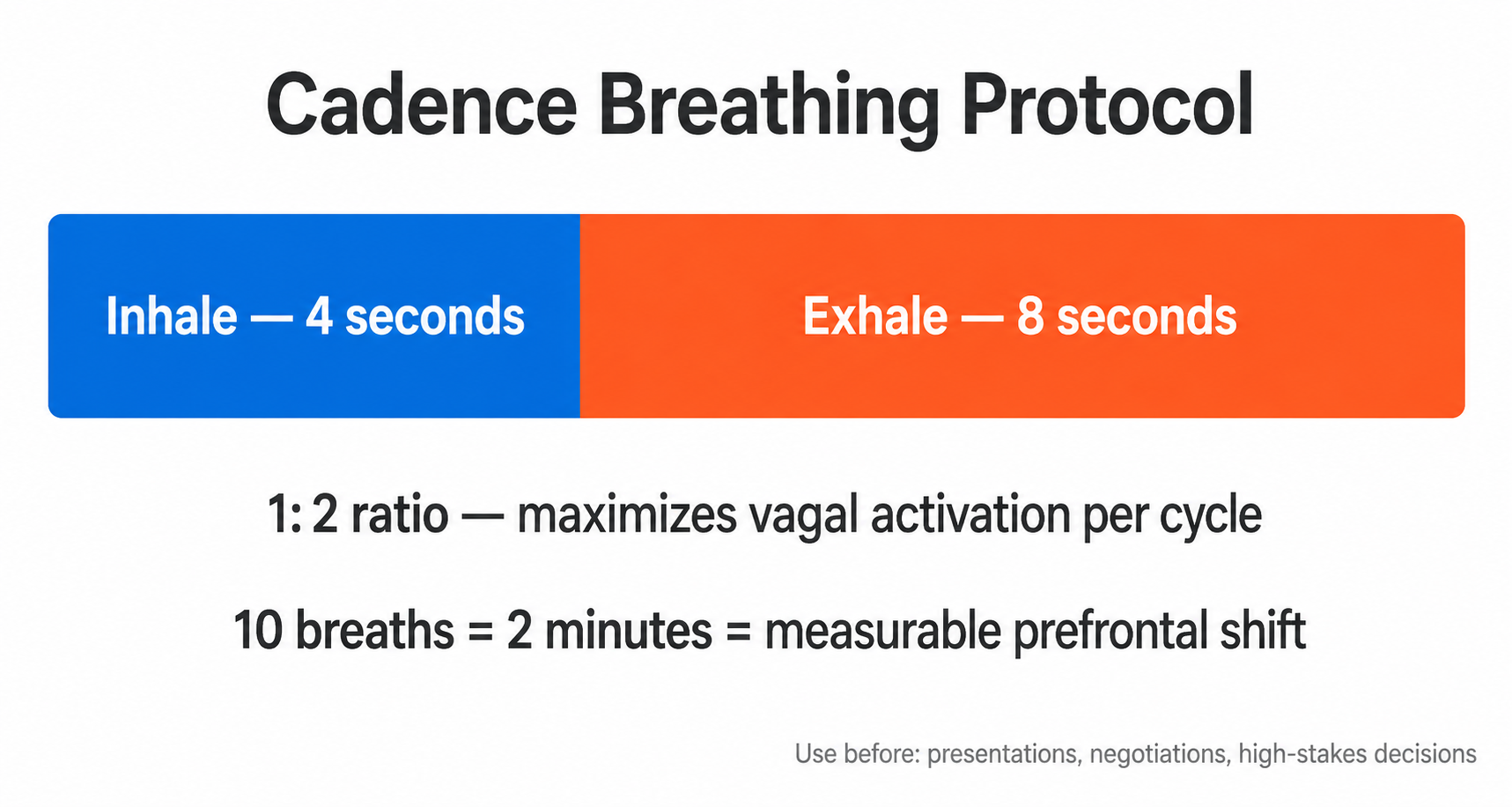
Ten breaths at this cadence. Two minutes. Measurable prefrontal engagement shift.
Use before any high-stakes moment: presentations, negotiations, difficult conversations, creative sessions. Two minutes of cadence breathing gives you access to your full cognitive capacity. Not as a belief. As a neurological consequence of the pathway described above.
Your breath controls your brain. Not metaphorically. Neurologically. The professionals who understand this have a structural advantage: they can access their prefrontal cortex on demand while everyone else is reacting from the amygdala.
If you want the complete framework: 7 techniques matched to 7 nervous system states, with progression protocols and real-time decision trees, that’s Cultivate Calm: Breath Mastery.
Citations
- Yackle, K., Schwarz, L. A., Kam, K., et al. (2017). Breathing control center neurons that promote arousal in mice. Science, 355(6332), 1411, 1415.
- Ma, X., Yue, Z. Q., Gong, Z. Q., et al. (2017). The effect of diaphragmatic breathing on attention, negative affect and stress in healthy adults. Frontiers in Psychology, 8, 874.
Build the physiological layer first. Cultivate Calm: Breath Mastery is the breath and nervous-system regulation foundation the rest of this work is built on: seven techniques matched to seven nervous-system states, with progression protocols and real-time decision trees.
Get Cultivate Calm: Breath Mastery ($27)