Around 500 BCE, three distinct civilizations (Greece, India, and China) independently began documenting the same observation: unchecked appetite leads to accelerated decline.
They had no contact with each other. They used different languages, different frameworks, different cosmologies. Yet they converged on nearly identical behavioral prescriptions.
That convergence is not a coincidence. It is evidence.
What Convergence Actually Means
When isolated systems arrive at the same solution independently, it usually means one of two things: the solution is correct, or the underlying problem is universal.
In this case, both are true.
Evolutionary biologist Richard Wrangham documented that human caloric overconsumption is historically anomalous. For most of human history, restraint was not a philosophy. It was a survival condition. The cultures that formalized restraint as a practice were doing something specific: they were encoding an adaptive behavior into a transmissible system before environmental scarcity enforced it.
The Japanese practice of Hara Hachi Bu (stopping at approximately 80% satiety) is the most studied version. Okinawan population data collected by Bradley and Craig Willcox shows that this cohort, among the longest-lived on earth, consumes an average of 11% fewer calories than mainland Japanese. The mechanism is not mysterious: fullness signals travel to the brain through a mix of nerve and hormone pathways (stomach stretch, CCK, GLP-1, leptin, ghrelin), and that signaling takes minutes to tens of minutes to catch up with actual intake. Stopping before fullness is felt is a behavioral correction for a known physiological delay.
The Greeks called the same principle sophrosyne: moderation as a cognitive discipline, not a moral virtue. The Stoics, particularly Epictetus and Musonius Rufus, prescribed deliberate restraint in eating as training for restraint in judgment. The practice was explicitly instrumental, not ascetic.
Ayurvedic medicine, codified in the Charaka Samhita (compiled from older oral tradition sometime between roughly 300 BCE and 200 CE), gives similar guidance: fill the stomach one third with food, one third with liquid, and leave one third empty. The reasoning given was digestive efficiency, not longevity. Different framing, similar prescription.
The Mechanism They All Found Without Naming It
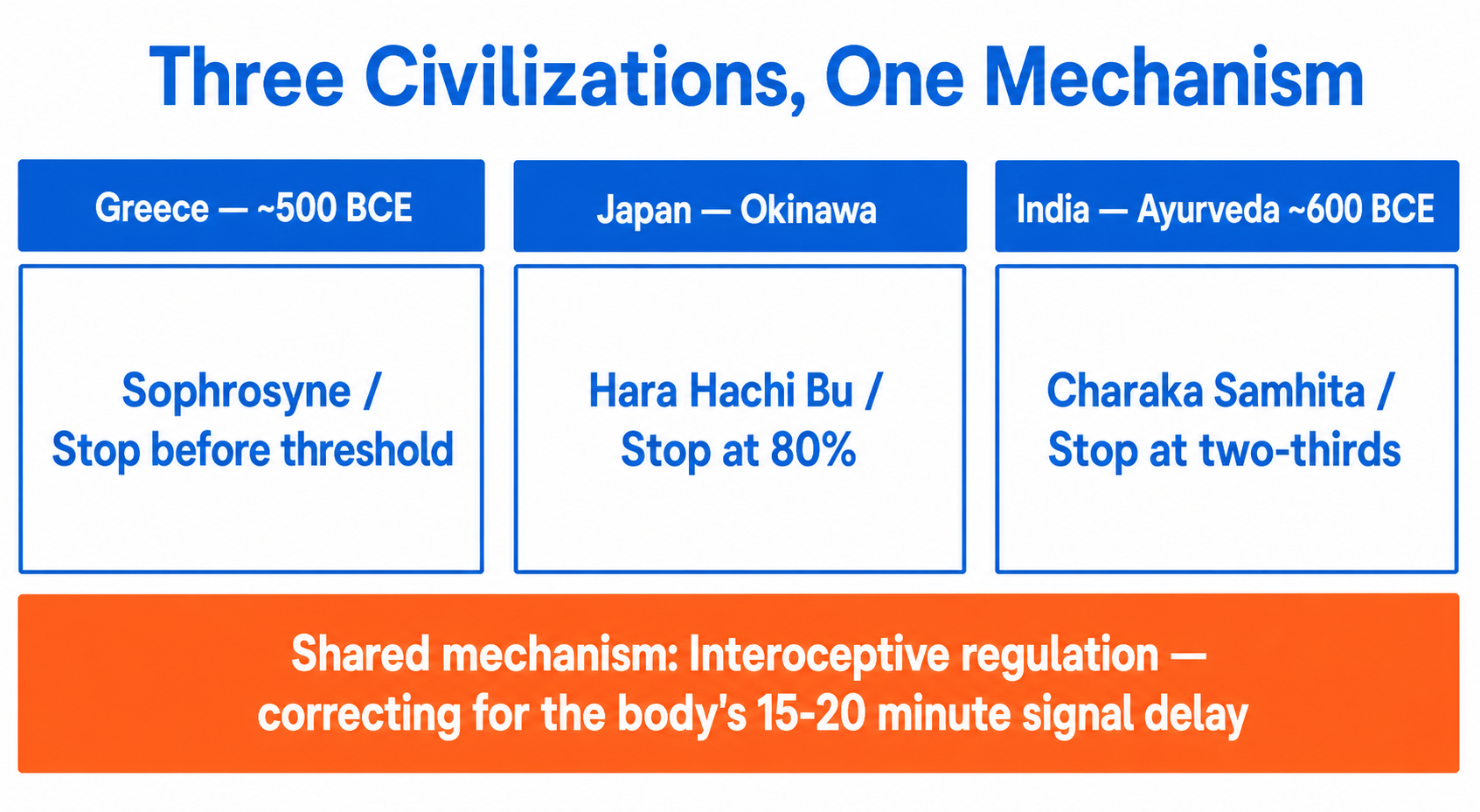
What these three systems independently discovered is what modern neuroscience calls interoceptive regulation: the capacity to read internal body states accurately and act on them before they reach threshold.
Research by Antonio Damasio (somatic marker hypothesis) and more recently by Anil Seth at the University of Sussex on predictive processing confirms the core problem: the brain does not receive real-time data from the body. It receives delayed, filtered signals and constructs a model. Trained interoceptive awareness, which is exactly what deliberate restraint practices build, improves the accuracy of that model.
The behavioral implications extend well beyond eating. Damasio’s work showed that patients with damage to interoceptive processing circuits made systematically worse decisions, even when their logical reasoning remained intact. The gut signal is not noise. It is data.
What the Greeks, the Japanese, and the Ayurvedic physicians were training, without the vocabulary for it, was decision quality through body signal literacy.
The Modern Implication
The self-help industry sells these practices as cultural imports: Hara Hachi Bu, mindful eating, Stoic journaling. The framing implies the value comes from the source culture.
It does not. The value comes from the mechanism, and the mechanism is species-level, not culture-specific.
When three independent civilizations converge on the same behavioral solution across 2,500 years and four continents, the correct response is not to romanticize the packaging. The correct response is to ask what they all found, strip the cultural overlay, and look at the underlying system.
In each case, the answer is the same: calibrating your response to internal signals, before those signals hit maximum intensity, produces better outcomes than reacting at threshold.
That applies to appetite. It applies to decision-making under pressure. It applies to every domain where you are managing a system with a built-in response delay.
The most durable behavioral technologies in human history were not invented once. They were invented repeatedly, by people who had no idea the others existed.
That is not a spiritual argument. That is a data point.
The first step in training interoceptive awareness is regulating the physiological layer. Cultivate Calm: Breath Mastery is where that starts.
Research Referenced
Richard Wrangham, Professor of Biological Anthropology, Harvard University. Research on the evolutionary biology of human caloric behavior and dietary patterns. Key work: Catching Fire: How Cooking Made Us Human (2009), Harvard University Press.
Bradley J. Willcox, Professor of Geriatric Medicine, University of Hawaii John A. Burns School of Medicine. Craig Willcox, Professor of Gerontology, Okinawa International University. Co-principal investigators of the Okinawa Centenarian Study, ongoing since 1975. Key work: The Okinawa Program (2001); Willcox et al., “Caloric restriction, the traditional Okinawan diet, and healthy aging,” Annals of the New York Academy of Sciences (2007).
Antonio Damasio, Director, Brain and Creativity Institute, University of Southern California (Dornsife College of Letters, Arts and Sciences). Originator of the somatic marker hypothesis. Key work: Descartes’ Error: Emotion, Reason, and the Human Brain (1994); The Feeling of What Happens (1999).
Anil Seth, Professor of Cognitive and Computational Neuroscience, University of Sussex; Co-Director, Sackler Centre for Consciousness Science. Research on predictive processing and interoceptive inference. Key work: Seth, A.K. (2021), “Interoceptive inference, emotion, and the embodied self,” Trends in Cognitive Sciences; Being You: A New Science of Consciousness (2021).