“We do not weep because we are sad; we are sad because we weep.”
William James, Principles of Psychology, 1890
James proposed this in 1890 and it drew heavy criticism, notably from Walter Cannon, though the idea never fully disappeared. It took another century of neuroscience, and the work of Lisa Feldman Barrett, to document precisely how the construction happens.
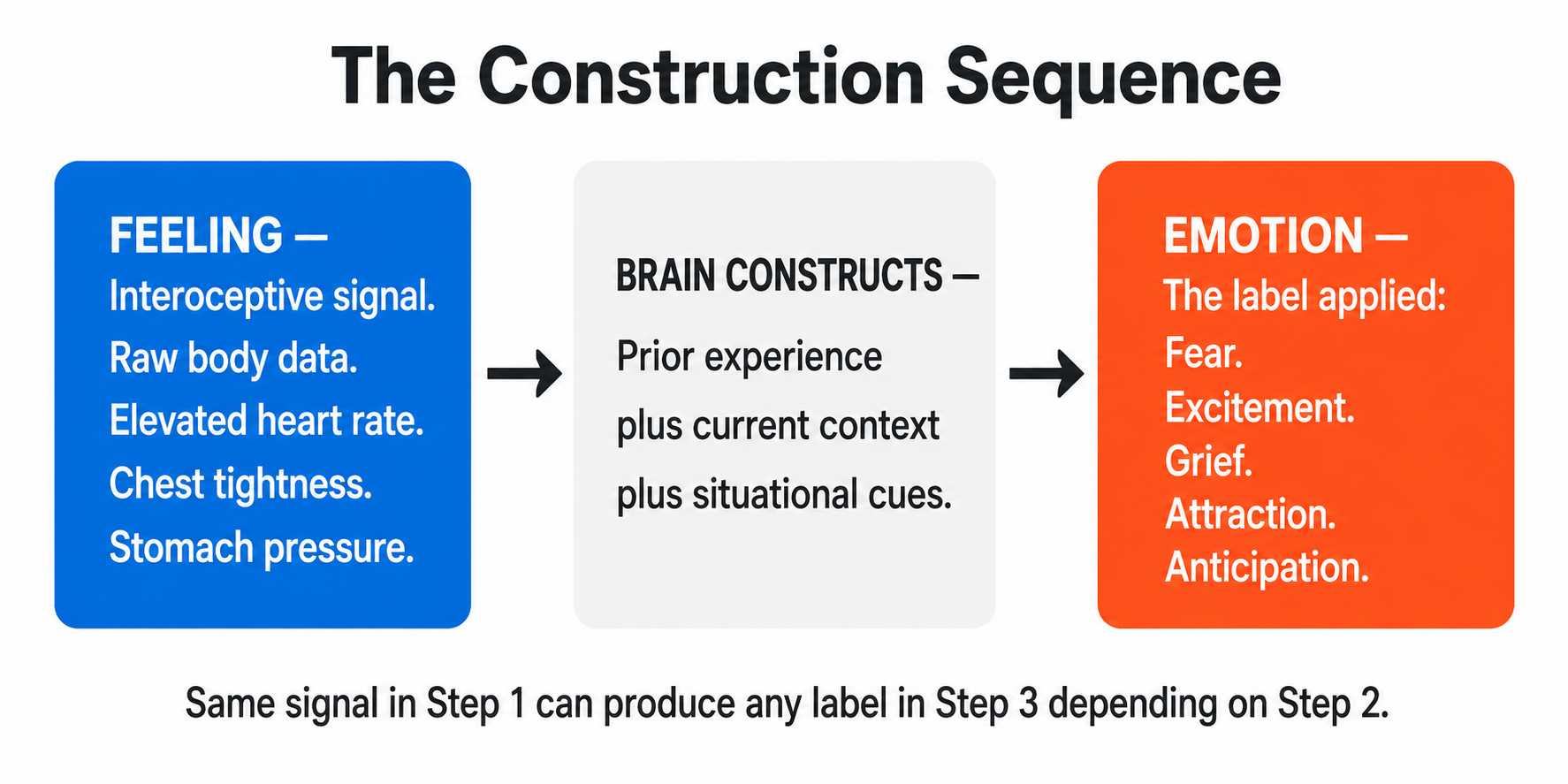
The feeling comes first. The emotion is the label. They are not the same thing.
What You Will Learn
- Why science treats “feeling” and “emotion” as two distinct processes
- How the brain constructs an emotion from an ambiguous body signal
- Why the same physiological state can produce fear, excitement, or attraction depending on context
- A 3-step practice for identifying the signal before the label arrives
The Distinction Science Actually Makes
In everyday language, “feeling” and “emotion” are used interchangeably. In neuroscience, they refer to two separate events in a sequence.
A feeling, in precise neurological terms, is an interoceptive signal: raw body data generated by the viscera, muscles, cardiovascular system, and skin, mapped continuously by the insular cortex. Elevated heart rate is a feeling. Tightness across the chest is a feeling. A wave of warmth is a feeling. These are physiological events with no inherent meaning attached.
An emotion is what the brain does next. Lisa Feldman Barrett at Northeastern University has documented through her theory of constructed emotion that emotions are not hardwired readouts of specific body states. They are the brain’s best prediction of what the current body signal means, built from prior experience, cultural learning, and current situational context. The brain receives an ambiguous interoceptive signal and generates a category: “this is fear,” “this is excitement,” “this is grief.”
The construction happens fast, below conscious threshold, and feels completely automatic. Which is why most people assume the emotion and the feeling are the same event. They are not. There is a gap between them, and that gap is where the most accessible lever for cognitive and emotional regulation sits.
How the Construction Works
A.D. Craig at the Barrow Neurological Institute established that the insular cortex maintains a continuous map of bodily state. It is the brain’s primary interoceptive processing region. What you consciously experience as a feeling is the insular cortex’s representation of that map surfacing into awareness, not the raw signal itself.
From that representation, the brain applies a label. The label is not determined by the signal alone. It is determined by the signal plus context plus prior experience. Stanley Schachter and Jerome Singer proposed this in 1962 through what became known as the two-factor theory of emotion: physiological arousal plus a cognitive label produces an emotion. Later replication attempts have been mixed, and the strong claim that changing the label alone changes the emotional experience is now disputed.
Donald Dutton and Arthur Aron documented this mechanism directly in a 1974 study at the University of British Columbia. Men crossing a narrow suspension bridge over a 230-foot drop were more likely to contact a research assistant and report attraction after the crossing than men who crossed a low stable bridge. The arousal produced by height and instability was inferred from the situation rather than directly measured, and many of the men appeared to label it as attraction rather than fear because the context offered an alternative explanation. Later attempts to replicate the finding have produced mixed results.
Paul Ekman’s influential thesis that emotions are universal and hardwired across cultures remains widely cited. Barrett’s research challenges the interpretation of the cross-cultural evidence, arguing that what appears universal is not the emotion category itself but the underlying physiological arousal. The label, she contends, is constructed from learned categorical knowledge and is far more variable across individuals and cultures than Ekman’s model allows. This debate is active in the literature. What both sides agree on: the physiological signal and the emotion category are not the same thing.
Why the Distinction Has Practical Weight
Most of what people identify as emotional suffering is not generated by the interoceptive signal itself. It is generated by the label, and more specifically by the thought chain that follows the label.
The label “anxiety” primes a specific set of threat-related thoughts. The label “excitement” primes anticipatory, approach-oriented thoughts. When the underlying physiological signal is essentially identical (elevated heart rate, increased respiration rate, muscle readiness), the downstream cognitive and behavioral consequences diverge entirely based on which label was applied.
James Gross at Stanford University has documented through his process model of emotion regulation that cognitive reappraisal (changing the label or the interpretation of a signal before the emotional response peaks) is measurably more effective than suppression for both wellbeing and performance outcomes. Suppression reduces external expression while maintaining or amplifying internal arousal. Reappraisal changes the construction before it fully consolidates.
The practical implication: the label is malleable. It is not a fixed readout. It is a prediction. And predictions can be revised.
The 3-Step Practice
This works in real time, during any emotional state. It takes under 2 minutes.
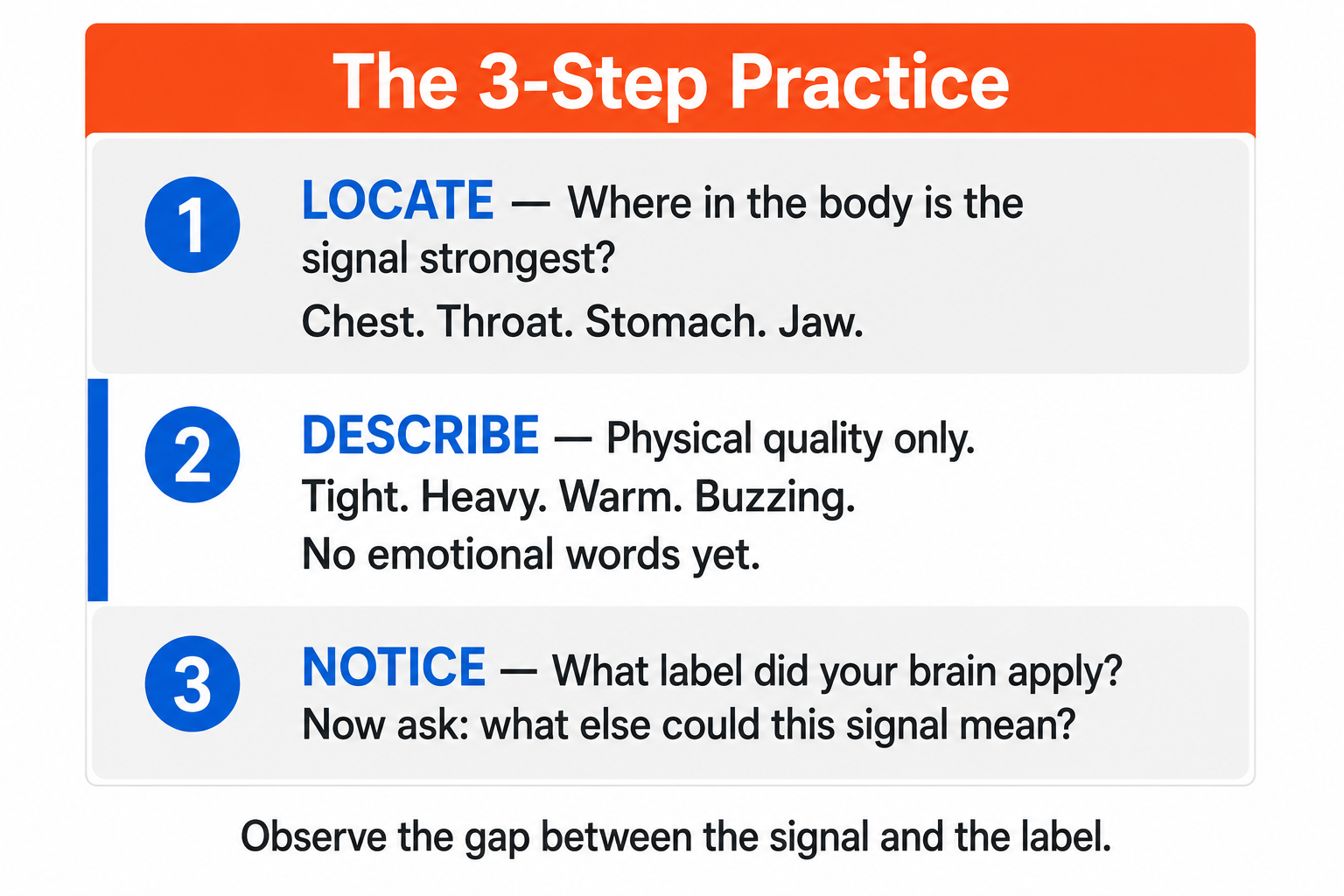
Step 1: Locate the signal in the body.
Before naming what you feel, identify where in the body the signal is strongest. Chest, throat, stomach, jaw, shoulders. Pick one location.
Step 2: Describe the physical quality, not the meaning.
Use physical descriptors only: tight, warm, heavy, buzzing, hollow, expansive, contracted. No emotional words at this stage. The goal is to observe the interoceptive data before the brain’s label overwrites it.
Step 3: Notice the label your brain has already applied.
What word did your brain attach to this signal? Now ask one question: what else could this same physical sensation mean in a different context? A tight chest before a presentation and a tight chest before a first date share the same physiological signature. One is labeled anxiety. One is labeled anticipation. The signal does not decide which.
This is not a reframing exercise in the coaching sense. It is a direct observation of the construction gap, the moment between the interoceptive signal and the emotion label. Increasing awareness of that gap is what makes it accessible.
What This Changes
If emotions are constructed predictions rather than fixed readouts, two things follow.
First, emotional experience is more variable than it feels. The same signal can be categorized differently depending on information, context, and prior experience. This is not a weakness in the system. It is the system operating as designed.
Second, the most effective point of intervention is not after the emotion is fully constructed, but in the construction process itself. The body signal generates the raw material. The brain applies the category. The practice is learning to observe the gap before the category locks in.
Takeaway: You do not have emotions. Your brain builds them from body signals, prior experience, and context. The construction is fast, automatic, and revisable.
Understanding what your body is signaling is the foundation of what I cover in Cultivate Calm: Breath Mastery. The physiological layer comes first.
Next in this series: The Quiet Mind. What actually happens in the brain when thought stops, and whether that state is trainable.
Sources
Barrett, L.F. (2017). How Emotions Are Made: The Secret Life of the Brain. Houghton Mifflin Harcourt. Northeastern University. [Theory of constructed emotion; emotions as predictions built from interoceptive signals, prior experience, and context]
Craig, A.D. (2009). How do you feel: now? The anterior insula and human awareness. Nature Reviews Neuroscience, 10(1), 59, 70. Barrow Neurological Institute. [Insular cortex as primary interoceptive processing region]
Schachter, S., & Singer, J.E. (1962). Cognitive, social, and physiological determinants of emotional state. Psychological Review, 69(5), 379, 399. [Two-factor theory of emotion: arousal plus cognitive label produces the emotional experience]
Dutton, D.G., & Aron, A.P. (1974). Some evidence for heightened sexual attraction under conditions of high anxiety. Journal of Personality and Social Psychology, 30(4), 510, 517. University of British Columbia. [Suspension bridge study: same arousal labeled differently based on situational context]
Ekman, P. (1992). An argument for basic emotions. Cognition & Emotion, 6(3, 4), 169, 200. [Cross-cultural universality of emotion expressions; contested by Barrett’s constructed emotion model]
Gross, J.J. (2001). Emotion regulation in adulthood: Timing is everything. Current Directions in Psychological Science, 10(6), 214, 219. Stanford University. [Process model of emotion regulation; cognitive reappraisal measurably more effective than suppression]
James, W. (1890). Principles of Psychology. Henry Holt. Harvard University. [Proposed that physiological changes precede emotional experience: “we feel sorry because we cry”]