“I think, therefore I am.”
, René Descartes, Discourse on the Method, 1637
Descartes was certain of one thing: the thought itself proved his existence. What he could not account for, and what no philosopher could until the 20th century, was what was generating the thought in the first place.
He assumed he was the author. He was not. Neither are you.
What You Will Learn
- Why “thought” is not a scientific category
- What actually generates a thought (mostly not you)
- The real number of thoughts per day, and why the figure everyone cites is fabricated
- One 2-minute experiment to observe your own thought-generation system directly
“Thought” Is Not a Single Thing
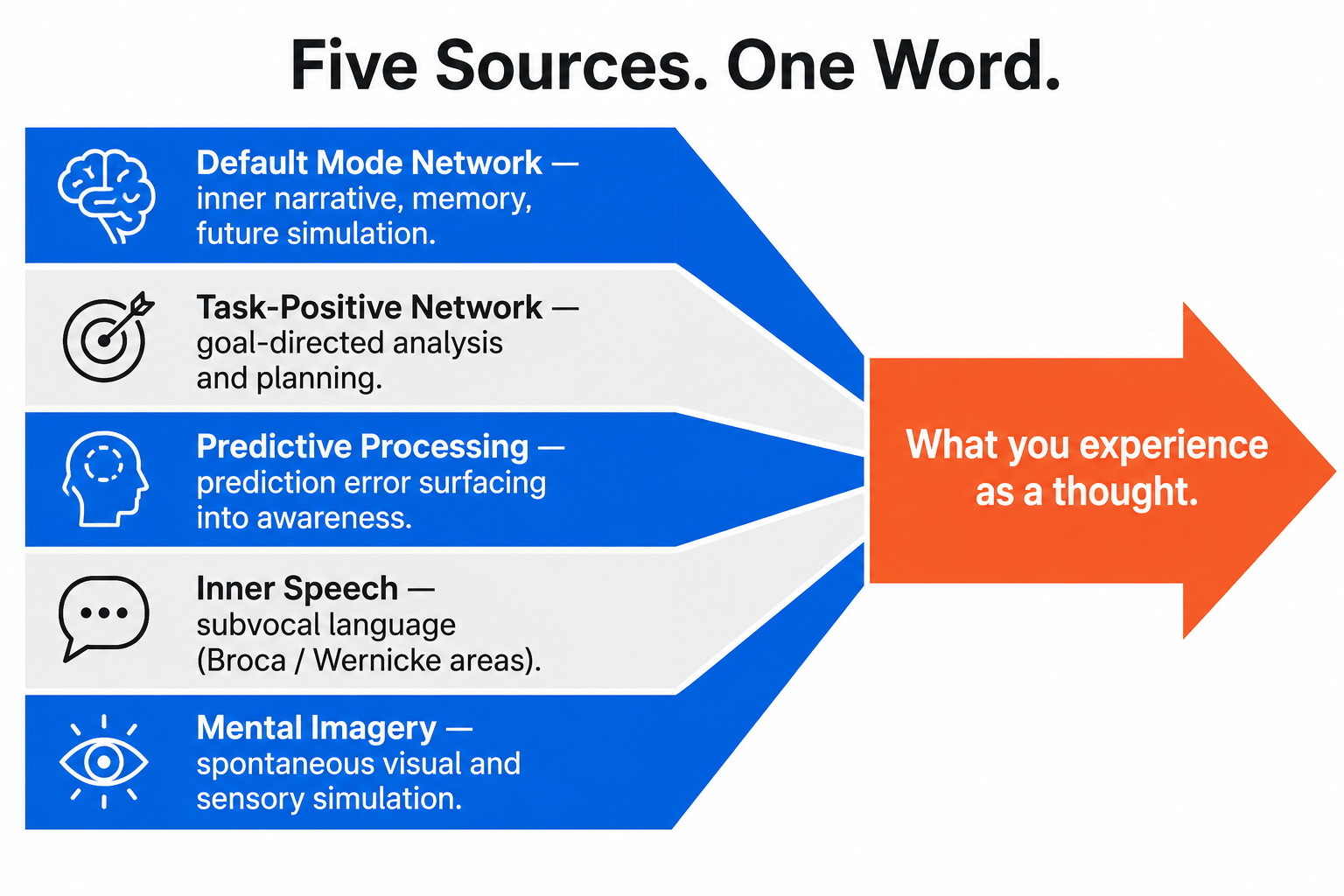
Science does not have a single definition of “thought” because the word covers at least five distinct neural events running through different systems, at different speeds, and with different degrees of conscious access.
The first is spontaneous default mode network (DMN) activity. When you are not focused on an external task, the DMN activates and generates self-referential processing: inner narrative, memory retrieval, future simulation, and social cognition. Most of what people call “my thoughts” is DMN output, not deliberate cognition.
The second is goal-directed activity from the task-positive network (TPN). When you are analyzing, planning, or solving a problem, the TPN is dominant and the DMN quiets. This is the category of cognition you are most aware of and most able to direct.
The third is predictive processing. Karl Friston at University College London developed predictive processing, an influential theoretical framework describing the brain as generating expectations about incoming sensory data and correcting for error when predictions fail. Many “thoughts” are prediction errors surfacing into awareness: the brain noticing a mismatch between what it expected and what it received.
The fourth is inner speech. Research by Charles Fernyhough at Durham University, building on Lev Vygotsky’s earlier work, established that inner speech is not the vehicle for thought. It is a form of thought. Subvocal language processing in Broca’s and Wernicke’s areas contributes to the stream of consciousness alongside other cognition, not after it.
The fifth is mental imagery: spontaneous visual and sensory simulation in the absence of external input. It runs in parallel with language-based processing and responds to different triggers.
When you experience “a thought,” you are typically receiving a blend of these five processes, not a single clean event with a single origin.
Where a Thought Comes From
The default assumption is that thoughts originate in conscious intention. The research does not support this.
Stanislas Dehaene at the Collège de France documented through global workspace theory that conscious awareness is downstream from thought generation, not the source of it. A thought reaches consciousness when it crosses an activation threshold sufficient to broadcast across multiple cortical regions. The generation occurs before you are aware of it.
Benjamin Libet’s readiness potential experiments (1983) showed that neural preparation for voluntary action precedes conscious awareness of the intention to act by several hundred milliseconds. More recent work by John-Dylan Haynes at Charité Berlin (2008, using fMRI) extended this finding: from brain activity, researchers could decode a simple left-or-right choice at above-chance rates up to 10 seconds before the person reported being consciously aware of having decided. It was a statistical tilt, not a reliable readout of the decision itself.
The thought was already in formation. You received it late.
That sentence is worth sitting with. Every person who has resolved at midnight not to react that way again, and then reacted exactly that way at noon, was working downstream from a process that had already run. The generation happens first. Awareness arrives after. This is not a character flaw. It is the architecture.
This is not a philosophical argument about free will. It is a mechanical description of how a system operates. Your cognition is largely automatic, and like most automatic systems, it runs on inputs rather than intentions.
The Number Everyone Cites Is Fabricated
The figure “70,000 thoughts per day” circulates widely in coaching and wellness content. It has no scientific source. No study produced it.
The only serious attempt to measure thought transitions was conducted by Tseng and Poppenk at McGill University, published in Nature Communications in 2020. Using neural decrement (tracking how brain activity changes as one thought state gives way to another), they identified approximately 6,200 thought-state transitions per day in resting participants.
Two clarifications matter here. First, what was measured was transitions between thought states, not discrete thoughts. “Thought” as a countable unit does not exist in neuroscience. What exists is continuous neural processing with detectable shift points. Second, 6,200 is a resting-condition measurement. It changes with environment, cognitive load, and attentional state.
What the figure confirms: a significant volume of cognitive activity occurs without deliberate initiation. Most of it does not require your permission to start.
The 2-Minute Experiment
The following takes 2 minutes. No equipment required.
Set a timer. Sit without a task. Do not attempt to stop thinking. Observe whatever arises and count each time your mental content distinctly shifts: a new topic, a new image, a transition from abstract reasoning to sensory memory, from present to past or anticipated future.
When the timer ends, note three things: the total number of shifts, whether you could identify the moment before a thought arrived (the pre-thought gap), and whether any single thought persisted for the full 2 minutes without fragmenting, evolving, or being displaced.
Most people find the count higher than expected. Most cannot identify the pre-thought moment. Almost no one holds one thought unchanged for the full 2 minutes.
This is not a relaxation protocol. It is a calibration. The goal is to observe the generative system directly before attempting to work with it. You cannot adjust what you have not observed.
What This Gives You
If a significant portion of your cognitive output is generated without deliberate intent, from DMN activity, prediction errors, and inner speech running below conscious threshold, then the most productive question is not “how do I think better?” It is: what conditions produce better thought inputs?
The physiological state you maintain, the environment you place yourself in, the sensory signals your brain is currently processing: these are the upstream variables. Deliberate cognition is downstream from all of them.
You now have an account of what a thought actually is and where it comes from. That account is the first tool. The system was always running. Now you can see it.
The next step is not another framework. It is an experiment that takes two minutes and requires nothing but a timer. It is in the section above. Most people who run it find the count higher than expected and cannot identify a single thought that held unchanged for the full duration. That result is the data. The next post in this series takes what the data points to: the body was involved before the thought arrived.
The practical framework for working with the upstream conditions starts at the physiological layer. Cultivate Calm: Breath Mastery is where that work begins.
Next in this series: The Thought Came First. Your Body Had No Choice. How the body participates in cognition before conscious awareness begins.
Sources
Friston, K. J. (2010). The free-energy principle: a unified brain theory? Nature Reviews Neuroscience, 11(2), 127, 138. [Predictive processing: the brain as a prediction machine correcting for error]
Fernyhough, C. (2016). The Voices Within: The History and Science of How We Talk to Ourselves. Basic Books. [Inner speech as a form of thought, not its vehicle]
Vygotsky, L. S. (1934/1986). Thought and Language. MIT Press. [Inner speech and the internalization of language as cognitive process]
Dehaene, S. (2014). Consciousness and the Brain. Viking. [Global workspace theory: conscious awareness is downstream from thought generation]
Libet, B., Gleason, C. A., Wright, E. W., & Pearl, D. K. (1983). Time of conscious intention to act in relation to onset of cerebral activity. Brain, 106(3), 623, 642. [Neural preparation precedes conscious awareness by hundreds of milliseconds]
Haynes, J. D., et al. (2008). Reading hidden intentions in the human brain. Current Biology, 18(3), 185, 190. [Brain predicts decision up to 10 seconds before conscious awareness, Charité Berlin]
Tseng, J., & Poppenk, J. (2020). Brain meta-state transitions demarcate thoughts across task contexts. Nature Communications, 11, 3480. [6,200 thought-state transitions per day; 70,000 figure has no scientific basis]