“All of humanity’s problems stem from man’s inability to sit quietly in a room alone.”
Blaise Pascal, Pensées, 1670
Pascal was diagnosing what modern neuroscience would eventually name the default mode network: the brain’s self-referential system that activates precisely when there is nothing external demanding attention.
He identified the problem with precision. He attributed it to moral weakness. The mechanism is structural, not moral. And unlike moral weakness, it is trainable.
What You Will Learn
- What the brain is actually doing during a “quiet mind” state
- Why the DMN and the task-positive network cannot both be fully active at once
- What flow state is neurologically and why it produces the experience of mental silence
- A protocol for accessing the rest phase your brain requires but rarely receives
What “Quiet” Actually Means in the Brain
The quiet mind is not a brain that has stopped producing activity. It is a brain in which self-referential processing has stepped back from the foreground.
Marcus Raichle and colleagues at Washington University characterized the default mode network in 2001, building on earlier resting-state metabolism findings. The DMN activates during rest, mind-wandering, self-referential thinking, and social cognition. It is the network that generates the inner narrator: the voice that reviews the past, rehearses the future, monitors social standing, and produces the continuous commentary that most people experience as their mental baseline.
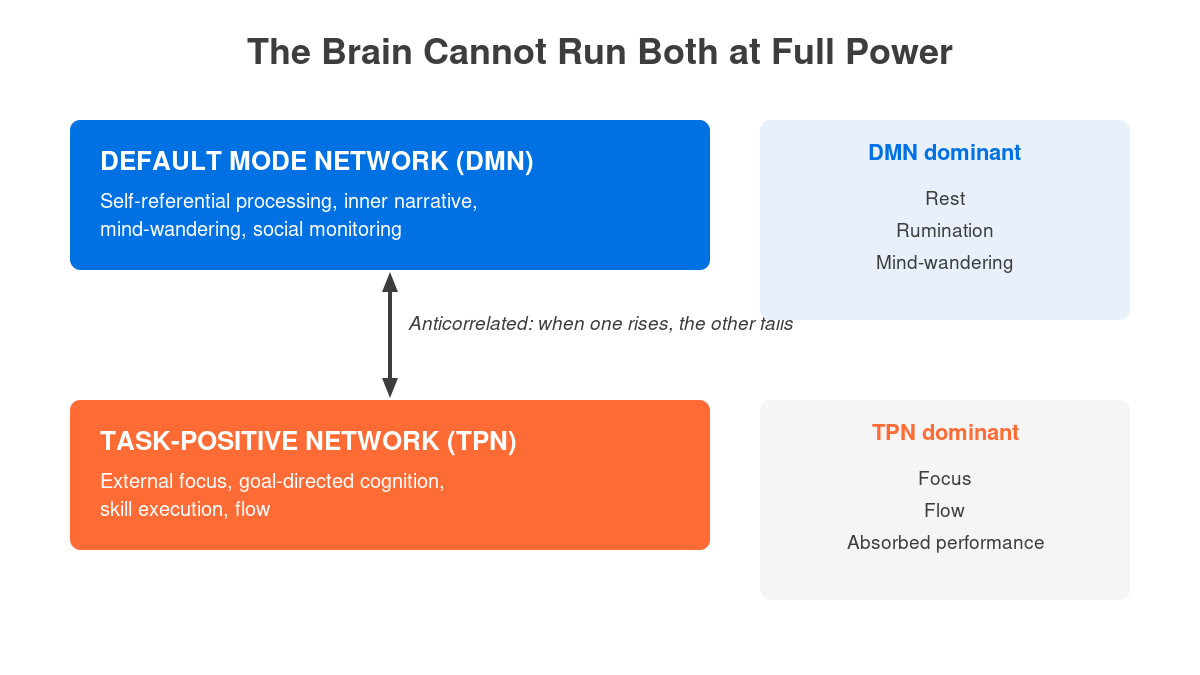
The DMN and the task-positive network (TPN) tend to be anticorrelated. When one is strongly engaged, the other is typically turned down. Sustained external task engagement drives TPN dominance and quiets DMN output. The experience of mental silence during focused work is not the brain doing less. It is the brain doing something different, with the self-referential layer temporarily offline.
Judson Brewer and colleagues (2011, then at Yale) used fMRI to compare experienced meditators with novices during meditation practice. Experienced meditators showed two things at once: reduced activity in the main hubs of the DMN, and a different relationship to whatever output remained, stronger coupling with the brain’s control regions, meaning less reactivity to self-referential content, less elaboration of it, and faster return to baseline after a thought arose. The quiet mind is not a brain that stops generating content. It is a brain that has learned not to amplify what it generates.
Flow: The Secular Version of Mental Silence
Mihaly Csikszentmihalyi at Claremont Graduate University spent four decades documenting what he called optimal experience: a state of complete absorption in a task where self-consciousness disappears and time perception distorts. His data, collected across cultures and professions, consistently identified the conditions that produce this state: a task with clear goals, immediate feedback, and a challenge level that matches the performer’s current skill. Too easy produces boredom. Too hard produces anxiety. The optimal band produces flow.
Arne Dietrich at the American University of Beirut proposed the transient hypofrontality hypothesis to explain the neurological substrate: during flow, prefrontal cortex activity decreases. The region responsible for self-monitoring, explicit planning, and social evaluation partially disengages. The cognitive overhead of watching yourself perform is removed. What remains is performance without commentary.
The experience of mental silence in flow is not emptiness. It is the absence of self-monitoring. The distinction matters because it changes the practical target. You are not trying to stop thinking. You are trying to stop the layer that watches the thinking.
Why Forced Stillness Fails at the Wrong Time
Nathaniel Kleitman, who with his graduate student Eugene Aserinsky identified REM sleep, also documented the basic rest-activity cycle (BRAC): a 90 to 120-minute rhythm of rising and falling cognitive alertness that runs throughout the waking day, not only during sleep. The brain cycles through periods of high-focus capacity and periods of reduced alertness and consolidation.
Attempting to maintain focused output during a low-alertness trough does not produce productivity. It produces degraded cognition and, over time, accumulated fatigue. The brain is not malfunctioning during a trough. It is consolidating the output of the previous cycle, pruning unnecessary activations, and preparing the next high-alertness window.
Forced distraction during the rest phase (checking messages, consuming content, low-grade scrolling) interrupts consolidation without providing genuine recovery. The trough passes without the brain completing its maintenance cycle. The next high-alertness window opens on a system that has not reset.
The practical consequence: 90 minutes of focused work followed by 10 to 20 minutes of genuine non-directed rest is a practice inspired by this research. It follows the rhythm the brain seems to run on, even if the exact numbers are a heuristic rather than a proven requirement.
The Protocol
This is based on Kleitman’s BRAC research. It requires no equipment and no particular skill. It does require the willingness to do nothing for a defined period.
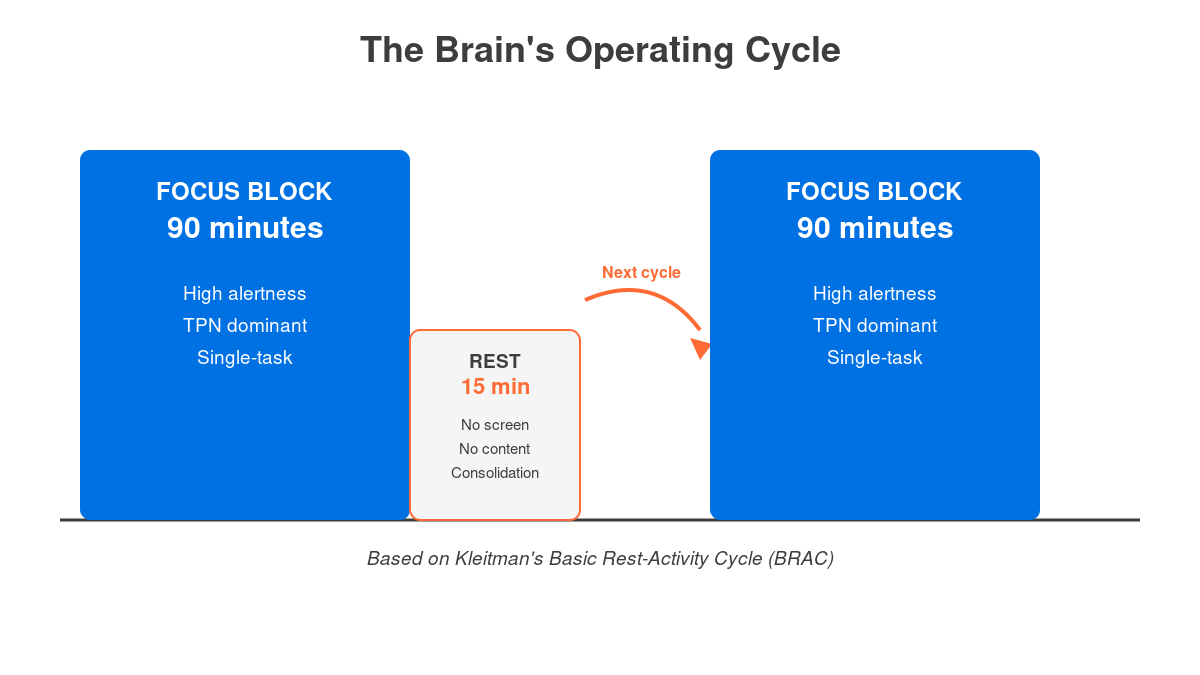
Step 1: Work in a focused block of 90 minutes on a single task or category of task. No task-switching. No interruptions if avoidable.
Step 2: At the 90-minute mark, stop. Set a timer for 15 minutes.
Step 3: During those 15 minutes: no screen, no audio, no content consumption. Sit or lie down. Eyes closed or soft unfocused gaze. Allow whatever arises in the mind without directing it. This is not meditation. You are not practicing anything. You are providing the conditions the consolidation process requires.
Step 4: When the timer ends, note the quality of focus in the next block compared with skipping the rest period.
Most people find the post-rest block noticeably sharper than a continuous work session of the same total duration. The effect is consistent with the ultradian data. It is also consistently resisted, because doing nothing feels unproductive in a way that degraded focus does not.
What This Changes
Pascal was correct that the inability to sit quietly is the source of considerable suffering. What he missed is that this inability is not a character defect. It is an untrained relationship with a biological system that defaults to self-referential activity when left without direction.
The quiet mind is not a destination reached by exceptional people under exceptional conditions. It is a neurological state accessible through a trained relationship with the DMN, through the natural mechanics of flow, and through respecting the rest phases built into the brain’s own operating cycle.
Takeaway: The brain quiets when it is either fully absorbed in a well-matched task or given genuine unstructured rest. Stillness is not an absence. It is a condition you can engineer.
The physiological layer of this system, the breath and nervous system regulation that sets the conditions for cognitive quiet, is the foundation of Cultivate Calm: Breath Mastery.
The full system these posts are built on, The Calibration Compass, the diagnostic-and-installation framework for engineering states like this one deliberately, is in development. This series is the groundwork.
Final post in this series: Every Thought That Is Hurting You Was Once Protecting You. Why the thought patterns causing the most damage today were once exactly what you needed.
Research Referenced
Raichle, M.E., MacLeod, A.M., Snyder, A.Z., Powers, W.J., Gusnard, D.A., & Shulman, G.L. (2001). A default mode of brain function. Proceedings of the National Academy of Sciences, 98(2), 676, 682. Washington University in St. Louis. [Identification of the default mode network]
Brewer, J.A., Worhunsky, P.D., Gray, J.R., Tang, Y.Y., Weber, J., & Kober, H. (2011). Meditation experience is associated with differences in default mode network activity and connectivity. PNAS, 108(50), 20254, 20259. Yale University / Brown University. [Experienced meditators show altered DMN reactivity]
Csikszentmihalyi, M. (1990). Flow: The Psychology of Optimal Experience. Harper & Row. Claremont Graduate University. [Conditions that produce flow]
Dietrich, A. (2003). Functional neuroanatomy of altered states of consciousness: the transient hypofrontality hypothesis. Consciousness and Cognition, 12(2), 231, 256. American University of Beirut. [Prefrontal downregulation during flow]
Kleitman, N. (1963). Sleep and Wakefulness. University of Chicago Press. [Basic rest-activity cycle / ultradian rhythm]
Pascal, B. (1670). Pensées. [Historical framing on the inability to sit quietly]